In brief
A discount rarely fixes a customer who was never a good fit, and a discount given for a promise buys nothing. For a firm turning over £500,000 at a 10% operating margin, a habitual 5% discount removes half the year's profit, and it takes 11.1% more work to earn it back. Revenue Journal explores three bad-fit clients from the team's own experience: an account kept alive with free services, a renewal discount traded for a handshake, and a company's biggest ever deal, which it walked away from.
The piece argues that choosing your customers is a luxury you earn through pipeline, and sets out a once-a-year review for deciding which customers to reprice, rescope, fix or let go.
A 5% discount can cost you half your profit
Take a small firm turning over £500,000 at a 10% operating margin. It makes £50,000 a year. Now knock 5% off everything, because that's what it took to win the work.

The discount costs £25,000, which is half the year's profit. To earn it back at a 50% gross margin you need 11.1% more work, because every pound of work that used to earn 50p of gross profit now earns 45p. That's 11% more delivery, from the same people, to end up where you started.
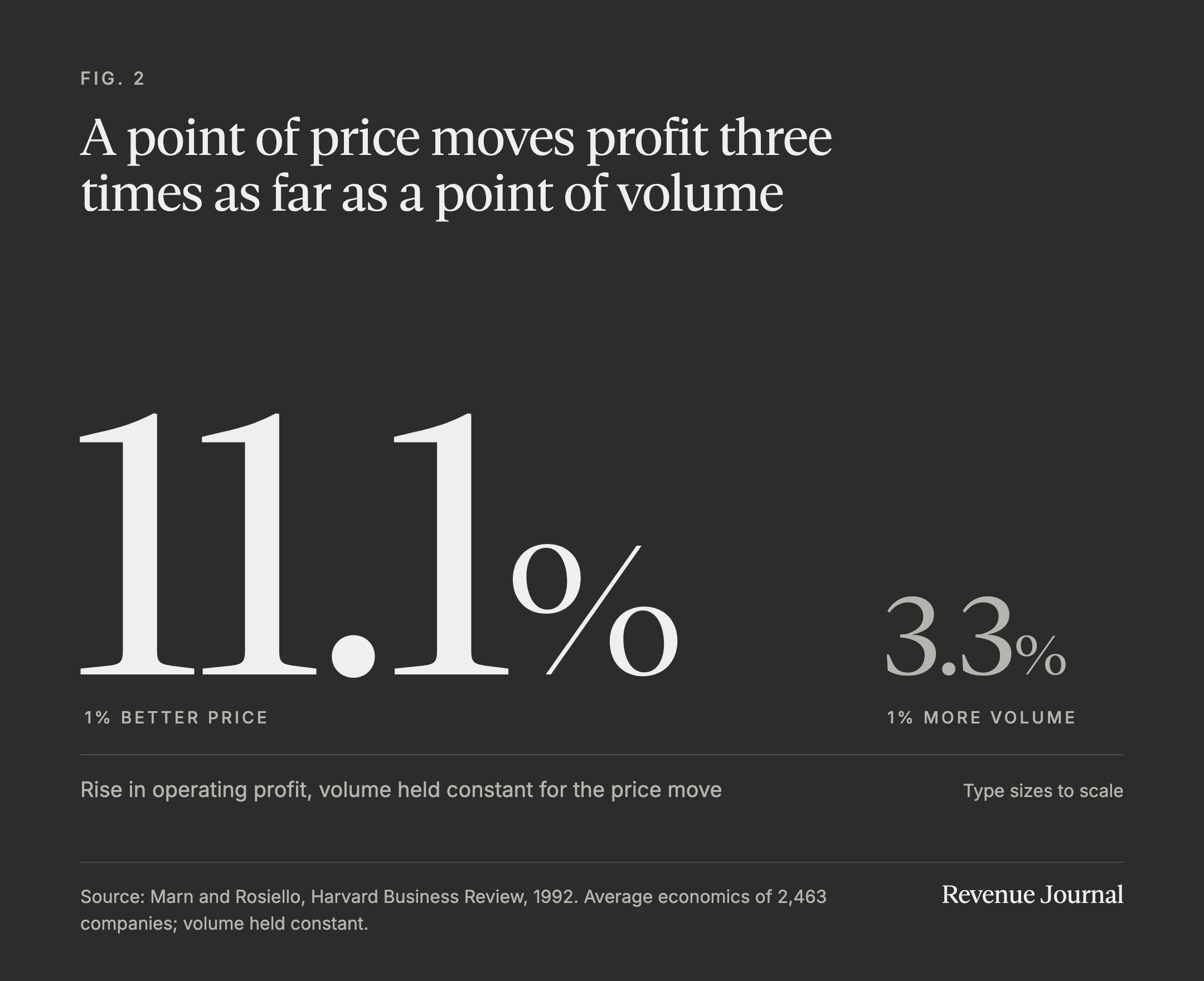
This is old news that most of us ignore. In 1992 Michael Marn and Robert Rosiello ran the same sum across the average economics of 2,463 companies. A 1% improvement in price, with volume held, lifted operating profit by 11.1%. A 1% rise in volume lifted it by 3.3% (Marn and Rosiello, 1992). The study is 34 years old, it covers large listed companies, and it assumes volume doesn't move when price does. Your multiplier will differ. The arithmetic doesn't age, and the thinner your margin, the worse it gets.
The real cost never reaches the invoice
Price is only the visible part. A bad-fit client is a slow puncture. You can keep driving on it. You just stop every few miles to pump it up, and after a while you stop noticing how much of the journey goes on the pump.
The pumping is the extra round of revisions, the favour that becomes standing scope, the invoice that needs three polite emails. None of it has a line on the P&L, so it feels free. Every hour of it comes out of the time you would otherwise spend selling to someone better.
We keep these customers because we price from fear. We charge what we would pay ourselves, or whatever avoids the next "no". The buyer is weighing your price against the problem you solve, and that is usually a much bigger number.
(If your problem is a team asking you to sign off discounts, we covered that in Discounts can save your quarter and still cost you the year. This piece is about the customers you choose and what you charge them.)
I learned this from three decisions I would make differently now.
Free help is not a relationship
The first was an account we really thought we could save. They had never been a completely good fit, but we got on well with their users and admins. Our plan was to turn that goodwill into relationships with senior stakeholders.
So we gave. Free services, extra support, anything that might tip it. The admins were delighted to take all of it. They did very little to advocate for us internally. We were subsidising the people with the least power to keep us.
A discount for a handshake is a discount for nothing
Same account, a later renewal. They had a new decision maker. Flash, sure of himself, and keen for us to know he was a tough negotiator. It was brutal. They pushed extremely hard and threatened to churn more than once.
The tell was there the whole time. They kept comparing us directly with one competitor. They told us, more or less, that the other company was better and cheaper, but that they wanted to make it work with us. They had a hard time explaining why. I didn't push the question as hard as I should have.
I capitulated. I gave the discount, and they signed on a handshake agreement that they would work hard with us to improve usage. They did no such thing. Within weeks the decision maker had gone cold.
My read is that they had already decided to leave. They renewed because they weren't ready to migrate yet, and they let me believe they wanted a longer-term relationship. Dirty stuff.
The mistake was still mine. If my read is right, I should have held the price. Either way the discount bought nothing, because I swapped real money for a promise I had no way of enforcing.
If I had that meeting again, I would tell him that if price is the only reason not to churn, he is working with the wrong vendor and should consider changing. Then I would hold the number.
We walked away from the biggest deal we had ever closed
A few years ago we closed a big enterprise customer, the largest new deal we had ever won at the time. It needed an enormous amount of custom development, plus careful technical planning just to hold scope creep back.
It ate a quarter of our very best technical people's time and nearly burned several of them out. Our CEO at the time saw what it was doing to a few employees he really trusted, and decided the juice wasn't worth the squeeze. We exercised the escape clause in the agreement and walked away.
We lost a lot of money doing it, and I won't dress that up. We also potentially saved ourselves a second quarter that would have cost more than the first.
That customer was the opposite of cheap on paper. What made them expensive was what they consumed: the people every other customer depended on. Chris Voss calls the wider category HALF clients, and his team found they took two to five times as long to produce the same revenue.
If you are the founder, you are the budget
I was a salaried account manager at a company with a technical team. When we gave away free services, it cost a budget line. When our best engineers were swallowed by one customer, there were other engineers.
A founder has no such cushion. You are the account manager, the technical team and the credit controller. Free help comes out of your evenings. A customer who swallows your best person may be swallowing you.
Then there is how they pay. In UK government research, 22% of businesses surveyed spent staff time chasing late payments, averaging 86 hours a year for each business affected (Department for Business and Trade, 2025). That is more than two working weeks. In a small firm, the person doing the chasing is usually the person who should be selling. In the same survey, 15% had avoided dealing with specific customers because of how they paid.

Choosing your customers is a luxury you earn
"Fire your bad clients" is fine advice. It is also much easier to say than to do when your mortgage depends on that client renewing.
You can only choose your customers from a position of strength. A founder with one big, difficult account and an empty pipeline has no choice to make. The work that buys you the choice is the unglamorous kind: new conversations at the top of the funnel, every week, including the weeks when delivery is shouting. Being choosy is a luxury, and you earn it by putting in the hard yards first.
So read the next section as a direction of travel. Reprice one customer this year. Hold one price. Each one makes the next refusal cheaper.
One caution before you cull anyone. Jason Cohen, who founded WP Engine, found that fewer than 10% of its customers were wiping out about a million dollars of profit a year (Startups for the Rest of Us, 2026). His first question was still whether the fault was his. One customer emailed support daily because the product gave them no way to make a simple change themselves. Fire that customer and you lose the person showing you what to fix.
Once a year, look hard at the bottom fifth
Once a year, list every customer and mark three things: what they pay, how much of your time they take, and how they pay. A spreadsheet and an honest afternoon is enough.
Then take the bottom fifth, one at a time. If the price is wrong, reprice at renewal. If the work has outgrown the price, reset the scope. If the pain is self-inflicted, fix your side. If none of that is possible, let them go at renewal, with notice and a recommendation for someone who suits them better.

For new work, put the next quote up by enough to make you slightly uncomfortable and see what comes back. If you would sooner win on something other than price, Brent Adamson's argument for helping buyers make the decision is worth your time.
And when someone asks "can you do it cheaper?", trade. Take a longer term, faster payment or a smaller scope in return. If they offer nothing you can hold them to, the price stays where it is. If their only argument is that a rival is cheaper, tell them what I should have said: then you may be with the wrong vendor.
I gave mine away for a handshake. You don't have to.
Frequently asked questions
How do I know if a client is a bad fit?
Compare three things for every client: what they pay, how much of your time they take, and how they pay. Bad fit clients sit near the bottom on at least two of the three. Free help that never turns into internal support for you, and promises made instead of commitments signed, are the early warning signs.
How do I raise prices on existing B2B clients without losing them?
Raise prices at renewal, with notice, and tie the new price to the value of the outcome. Where you can, offer a choice: the new price at the current scope, or the current price for a smaller scope. A client who cannot easily leave will usually pay the full price.
Should I give a discount to win or keep a client?
Only as a trade. Give a lower price in return for something you can hold the client to, such as a longer term, faster payment or a smaller scope. For a firm at a 10% operating margin, a 5% discount given for nothing removes half the profit on that work.
What should I do when a client threatens to leave over price?
Ask why they want to stay. If they say a competitor is better and cheaper but can't explain why they are still with you, get the real reason before you move on price. If price is the only reason to stay, they may be with the wrong vendor. Any discount you do give should be traded for something you can hold them to.
How do I fire a client professionally?
First check whether the problem is yours. A client who needs constant help may be showing you a gap in your own service. If it is not, let them go at renewal, give clear notice, say plainly that you are not the right fit, and recommend an alternative if you can.
About Revenue Journal
Revenue Journal is where B2B executives share first-hand growth strategies and hard-won insights. Published by Aira. www.aira.app/revenue-journal
Sources
- Marn, M. V. and Rosiello, R. L., Harvard Business Review, "Managing Price, Gaining Profit", 1992
- Department for Business and Trade and Office of the Small Business Commissioner (London Economics), "Late payments research: impact on the UK economy", 2025
- Startups for the Rest of Us, "Episode 857: Finding Hidden Multipliers in Your Business (with Jason Cohen)", 2026
- Revenue Journal, "Former FBI Hostage Negotiator Chris Voss on B2B Sales Negotiations"