
In brief
88% of account managers believe excellent service is how accounts grow, yet Gartner found it makes customers more likely to stay with no significant effect on whether they buy more (Gartner, 2019). With 73% of sales leaders now prioritising existing customers (Gartner, 2025), we'd argue that B2B account growth needs an owner who works for the company, and that five changes are required to make that happen.
Ask account managers how to grow an account and close to nine in ten will give you the same answer: delight the customer. Gartner asked, and 88% said excellent service was the best route to growth (Gartner, 2019). Then Gartner tested that belief against data from customers. Service did make customers more likely to stay, but had no significant effect on whether they bought more.
That should worry anyone relying on existing customers for growth, which as of 2025 was most sales leaders: 73% were prioritising it (Gartner, 2025). If the people responsible for B2B account growth believe the wrong thing about how it happens, that priority stays on a slide.
I believed it for longer than I should.
Service keeps customers. It doesn't grow them.
What did make customers buy more was something Gartner calls customer improvement. The account manager brings the customer new ideas about how to run their business, such as a way to make money, save money or reduce risk, and shows clearly what the relationship has delivered so far. Account managers who did this well increased the likelihood of growth by 45% and of retention by 94% (Gartner, 2019).
Read those two findings together. The activity most account managers prioritise keeps customers but does little to grow them. The activity that grows customers keeps them too.
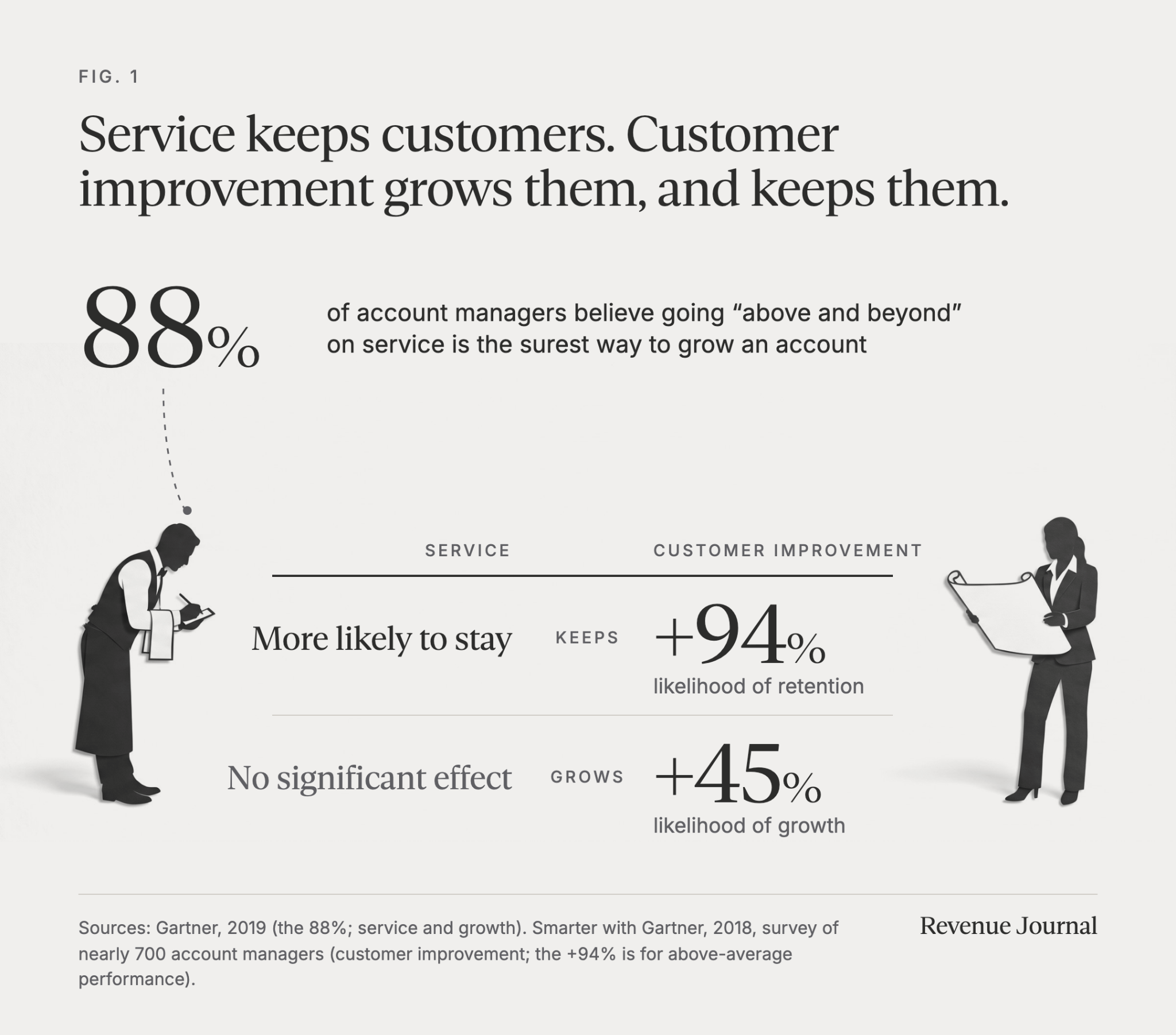
The results show up where companies invest most. In a separate Gartner survey, 95% of chief sales officers expected their key accounts to grow faster than the rest of the business, yet 58% of B2B sales organisations missed quota on those same accounts (Gartner, 2021). The customers sales leaders expect the most from are the ones most of them are falling short on.
One person, two jobs
Most organisations I've worked with give account managers two jobs. The first is looking after the customer: fixing problems, answering questions, being the person they call. The second is growing the account: finding the next problem worth solving and asking the customer to invest in solving it.
For me, the first crowded out the second all the time. Service work arrives with a deadline and someone waiting for an answer. Growth work has no deadline, and it means starting a commercial conversation the customer can say no to. Clearing the inbox is psychologically far easier. Comp plans can make it easier still, when keeping revenue pays much the same as growing it. In my experience, retention and expansion incentives are some of the hardest to get right, and some of the easiest for reps to game.
Anyone with more than one child will recognise the pattern. The one who is screaming gets the attention, whatever the others need. Account managers work the same way, with one important difference: you don't owe your customers equal attention. In my experience, the loudest are often the poorest fit and the least likely to renew or grow. When Chris Voss's team measured their most difficult clients, those clients took two to five times as long to generate the same revenue as straightforward ones, which is why he argues for walking away from bad-fit clients.
You don't owe your customers equal attention.
I'm a bit of a people pleaser, which is exactly the type that often ends up in account management and customer success. The instinct is valuable. Customers notice it. But pointed only at keeping customers comfortable, it produces the pattern Gartner found: plenty of service, not much growth. If you're hiring for these roles, screen for commercial courage as well as empathy. JR Butler's case for hiring on traits rather than CVs applies here too.
Who do your account managers work for?
The moment this changed for me came years ago. I was pushing to get a feature onto the product roadmap for one of my customers. It would have solved a problem that was quite specific to them. They were a very large customer, so I felt justified.
Daniel, our CEO, saw it differently. He told me that, from the way I was talking, it sounded like I worked for the customer rather than for the company.
He was right, and it's a lesson that is easy to forget. An account manager represents their company to the customer, not the other way round. Most of the time those interests line up, because growing an account usually means solving more of the customer's problems. When they drift apart, the job is to steer the customer back to where your company can genuinely help, not to bend the company around one customer.
An account manager represents their company to the customer, not the other way round.
I saw that play out with another large customer. Our product was built for sales teams, and its marketing features trailed our nearest competitors'. New leadership had turned this customer into a far more marketing-led organisation, which made it a worse fit despite its size. Rather than build out marketing features to capture all of that value, we sold them integrations with products that did the job better. That kept them happy and freed us to focus on customers heading where we could help most.
Organisations look after their most valuable customers best, and the research says that pays. A Journal of Marketing study of more than 300 business units across industries found that prioritising top-tier customers strengthened those relationships, without harming relationships with smaller customers, and cut sales and marketing costs (Homburg, Droll and Totzek, 2008). Senior attention, specialist time and influence over the product all follow spend. A customer who depends on one account manager's goodwill is exposed, because that goodwill can disappear with a reorganisation or a change of job. Once I understood that, I put my discretionary time into the customers willing to meet me halfway. Invariably, the ones who grew their spend and got real help alongside it were the happiest customers I had. That is what Gartner's retention figure for customer improvement would predict, and it fits Brent Adamson's argument about frame making: helping customers decide well matters as much after the contract as before it.
A client owned by one person can leave with them
Left alone long enough, order-taking hardens into something riskier. In a previous role, I worked with a number of services businesses, including consultancies and PR firms, where the same senior people had owned the same accounts for years. The relationship lived in their heads and their phones, and anyone else who wanted to speak to the client had to go through them.
Some guarded their clients closely, because the accounts they controlled had become their main source of value to the firm. We talked often with their management about the risks: key people leaving with clients, clients turning price sensitive because nobody brought them anything new, and technology changing what clients needed. The arrangement served neither the business nor the account owners. A book of business tied to one person is capped by what that person can do.
A book of business tied to one person is capped by what that person can do.
The first risk is measurable. BTI Consulting asked corporate legal clients whether they would follow their primary law firm partner to another firm. In 2023, 44% said they would, up from 12 to 15% before the pandemic (BTI Consulting, 2023). Put that in money. If a partner managing a £2m book of clients leaves, a 44% follow rate puts £880,000 of revenue at risk. I've heard plenty of similar stories from consultancy and recruitment firms.

Record keeping beats forced collaboration
The best answer to this I've seen came from a global accounting and advisory firm. It separated the two jobs. Accountants and consultants owned the long-term client relationships. A much smaller team of professional salespeople used those relationships to sell additional services to existing clients, and to win new clients through the accountants' networks. The firm used a lot of data to point both groups at the right clients.
There was real tension between the relationship owners and the sales team, and the firm resolved it through process. If a contract was coming up for renewal, or a client wasn't buying services the firm would expect them to need, the salespeople could approach that client without asking permission. Leadership stopped trying to make two groups with different instincts collaborate, and made the accountants keep accurate records of what each client had and needed instead. Enforcing record keeping turned out to be a much simpler problem than forcing collaboration.
Enforcing record keeping turned out to be a much simpler problem than forcing collaboration.
I can't share their numbers, but the change showed in how the business ran. Account growth became a professional process instead of something left to individual partners. The firm could set KPIs and growth targets for work that had never been measured. And it could standardise how clients were managed across regions, which had been impossible while each partner ran their accounts their own way.
Five changes that make B2B account growth someone's job
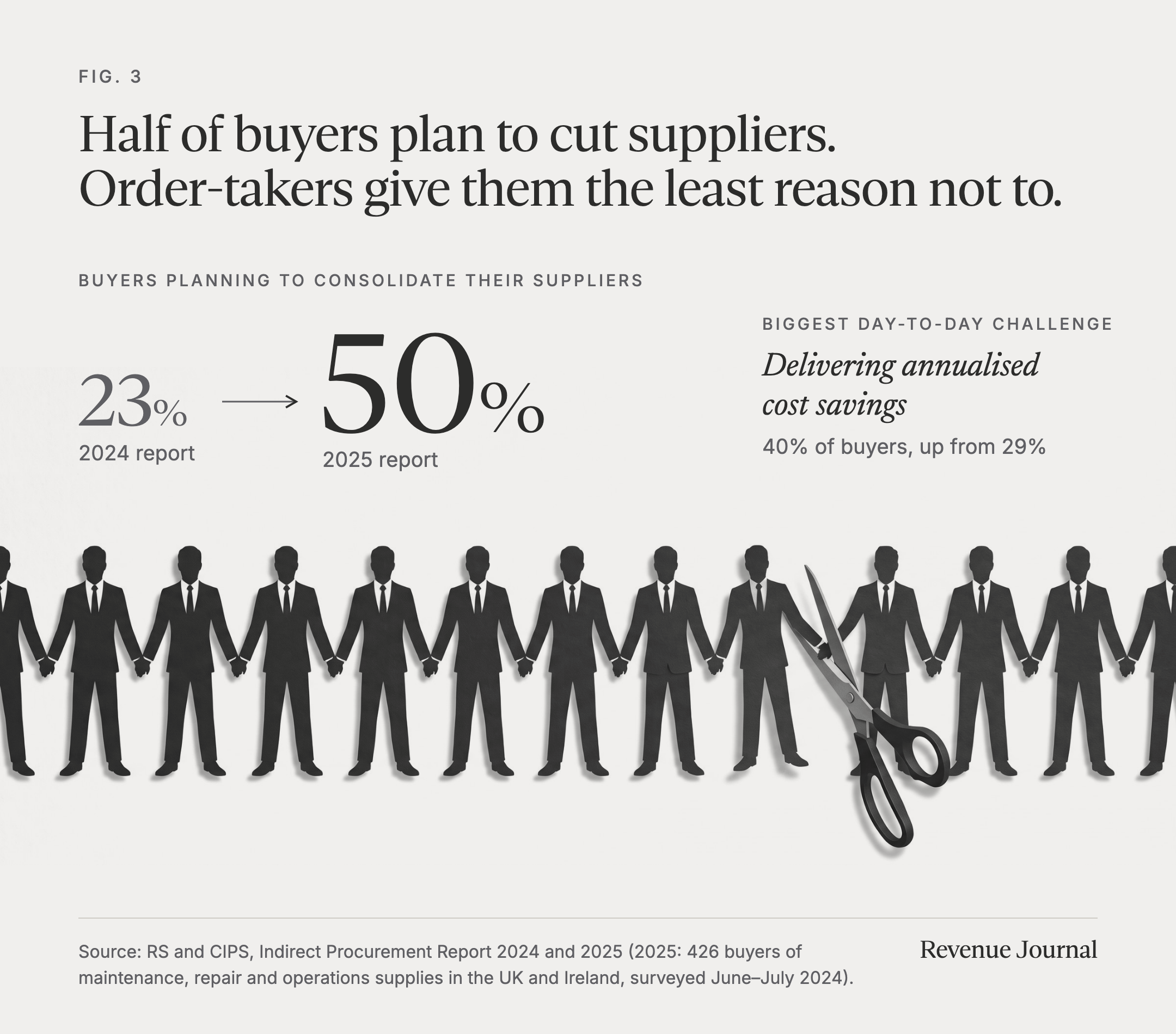
Buyers are raising the stakes. Half of the 426 UK and Irish procurement professionals in the 2025 RS and CIPS survey planned to cut their number of suppliers, up from 23% a year earlier (RS and CIPS, 2025, MRO procurement). A supplier that has only been processing orders gives the buyer little reason to keep it. None of these changes needs a reorganisation to start.
1. Be clear who account managers work for. They represent the company to the customer. Growing a customer, with real value attached, is one of the most useful things they can do for that customer, because it puts more of the organisation behind them.
2. Give service and growth separate owners. Gartner's own recommendation is to consider a customer success function that takes on service, so account managers can focus on growth (Gartner, 2019). In a small team, that might mean one person with protected time for each. What matters is that someone is explicitly responsible for growth.
3. Make client knowledge belong to the business. What a client buys, what they need and when their contracts renew should be recorded, not held in one person's head. Enforce record keeping, not collaboration.
4. Agree triggers in advance. Decide which events open an account to a growth conversation: an upcoming renewal, a gap in what the client buys, a change in their business. When one happens, the person responsible for growth acts without asking permission. Renewals deserve particular care, and as Chris Voss explains on renewal negotiation, they are rarely only about price.
5. Measure share of wallet. Retained revenue shows which customers stayed. Share of wallet shows how much of each customer's potential spend you are capturing, and therefore where growth is still available. To estimate it, compare what each customer buys from you with what a business of its size and sector typically spends in your category. Measure that outcome rather than the activity around it. Stephan Schiffman's warning about activity metrics applies to account teams as much as to new business.
Daniel's challenge is worth putting to your own team. Listen to how your account managers talk about their customers. If it sounds like they work for the customer, you have a service function. If you want account growth, someone has to work for the company.
Frequently Asked Questions
Does good customer service grow B2B accounts?
Gartner found that 88% of account managers believe excellent service is the best way to grow an account. When tested against customer data, service made customers more likely to stay but had no significant effect on whether they bought more. What drives growth is customer improvement: bringing customers new ideas about how to run their business, which increased the likelihood of growth by 45%.
Why are B2B sales leaders prioritising existing customers?
Gartner found 73% of chief sales officers prioritising growth from existing customers for 2025. Delivering it is harder: in a 2021 Gartner survey, 95% of sales leaders expected key accounts to outgrow the rest of the business, yet 58% of sales organisations missed quota on them.
Who should account managers work for?
An account manager represents their company to the customer. Most of the time the two sets of interests align, because growing an account means solving more of the customer's problems. When they diverge, the account manager's job is to steer the customer towards where the company can genuinely help.
What is key person risk in account management?
Key person risk is the exposure a business carries when one individual owns a client relationship. If that person leaves, the client may follow. BTI Consulting found 44% of corporate legal clients would follow their primary partner to another firm in 2023, up from 12 to 15% before the pandemic.
How should account management and customer success work together?
They should own different jobs. Gartner recommends considering a customer success function to take on service so account managers can focus on growth. Agreed triggers, such as an upcoming renewal or a gap in what the customer buys, decide when a growth conversation happens.
About Revenue Journal
Revenue Journal is where B2B executives share first-hand growth strategies and hard-won insights. Published by Aira. www.aira.app/blog
Sources
- Gartner (2025), survey of 243 CSOs and senior sales leaders, fielded Oct to Nov 2024
- Gartner (2021), 95% of CSOs expect higher growth from key accounts, 58% miss quota on them, survey Aug to Sep 2021
- Gartner (2019), press release on account growth and Smarter with Gartner on customer improvement
- BTI Consulting (2023), Clients Likely to Follow Laterals Up 3X
- RS and CIPS (2025), Indirect Procurement Report, 426 respondents, UK and Ireland
- Homburg, Droll and Totzek (2008), Customer Prioritization: Does It Pay Off, and How Should It Be Implemented?, Journal of Marketing 72(5), 300+ business units