In Brief
When a key account threatens to leave at renewal, most B2B sales teams reach for a discount. That reflex is usually wrong. Chris Voss, former FBI lead international hostage negotiator and author of Never Split the Difference, told Aira CEO Daniel Wikberg that a renewal threat is a test, and the way you respond tells you who you are dealing with. Most threats fall into one of three types: the leverage-poor bluff, the last-minute chipper, and the far more common buyer who simply wants to know the fee still matches the value. A discount fixes none of them. McKinsey found that B2B tech companies with best-in-class pricing practices, including firm limits on discounting, run net revenue retention around 16 points higher than peers (McKinsey, 2025). This article covers how to read the threat, the one question Voss uses to do it, and when to let an account walk.
In conversation with Chris Voss: how to tell a renewal bluff from a real threat
With Chris Voss, founder and CEO, Black Swan Group | By Tom Deane
The renewal call usually goes the same way. The customer mentions they have been looking at alternatives. The account manager hears the logo walking out of the door. By the end of the meeting, a discount is on the table.
We have all done it. Many of us were trained to, either directly or through conditioning. Protect the logo, protect the number, worry about margin later.
Chris Voss thinks that reflex gets B2B renewal negotiation backwards. In the conversation behind our piece on why B2B sales teams pitch too much and listen too little, Daniel put a familiar scenario to him: a big customer threatens to switch vendors at renewal unless they get what they want. “Sometimes it’s just a bluff and sometimes it’s real,” as Daniel put it. How do you tell the difference?
Instead of a script for saving the deal, Voss offered a way to find out who is on the other side of it.
“You’ve got to diagnose the situation from the beginning.” - Chris Voss
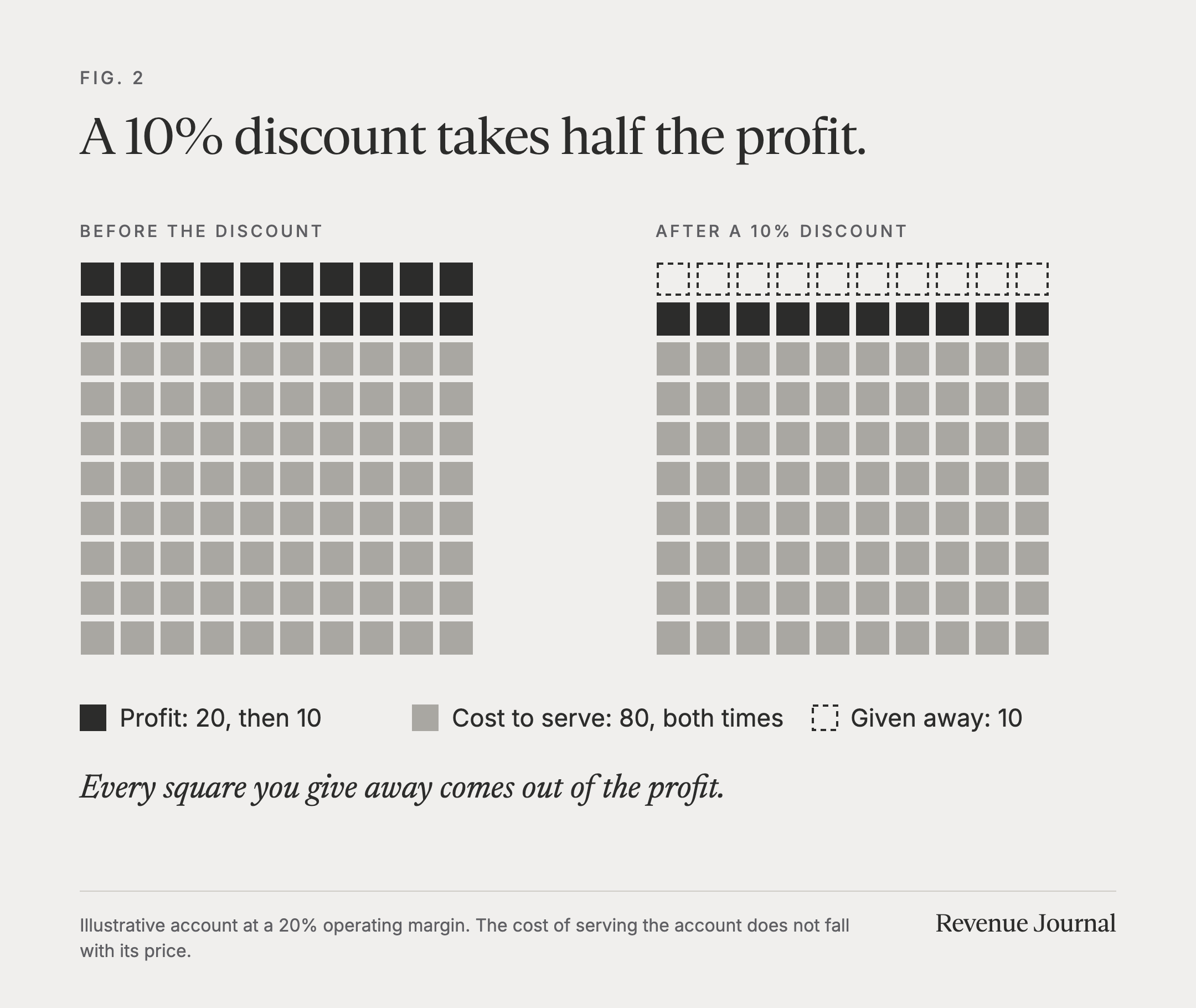
A 10% renewal discount costs half the profit
McKinsey studied 98 US B2B SaaS companies. Those with best-in-class pricing practices, including firm limits on discounting, ran net revenue retention around 16 percentage points higher than peers (McKinsey, 2025).
That gap compounds. Top-quartile-valued SaaS companies retain 113% of revenue from existing customers, against 98% for the bottom quartile, and trade at a median 24 times revenue against five (McKinsey, 2025).
Run that forward on a EUR 10m customer base. At 113%, it becomes roughly EUR 18.4m in five years without a single new logo. At 98%, it shrinks to about EUR 9m. Same customers. Twice the business.
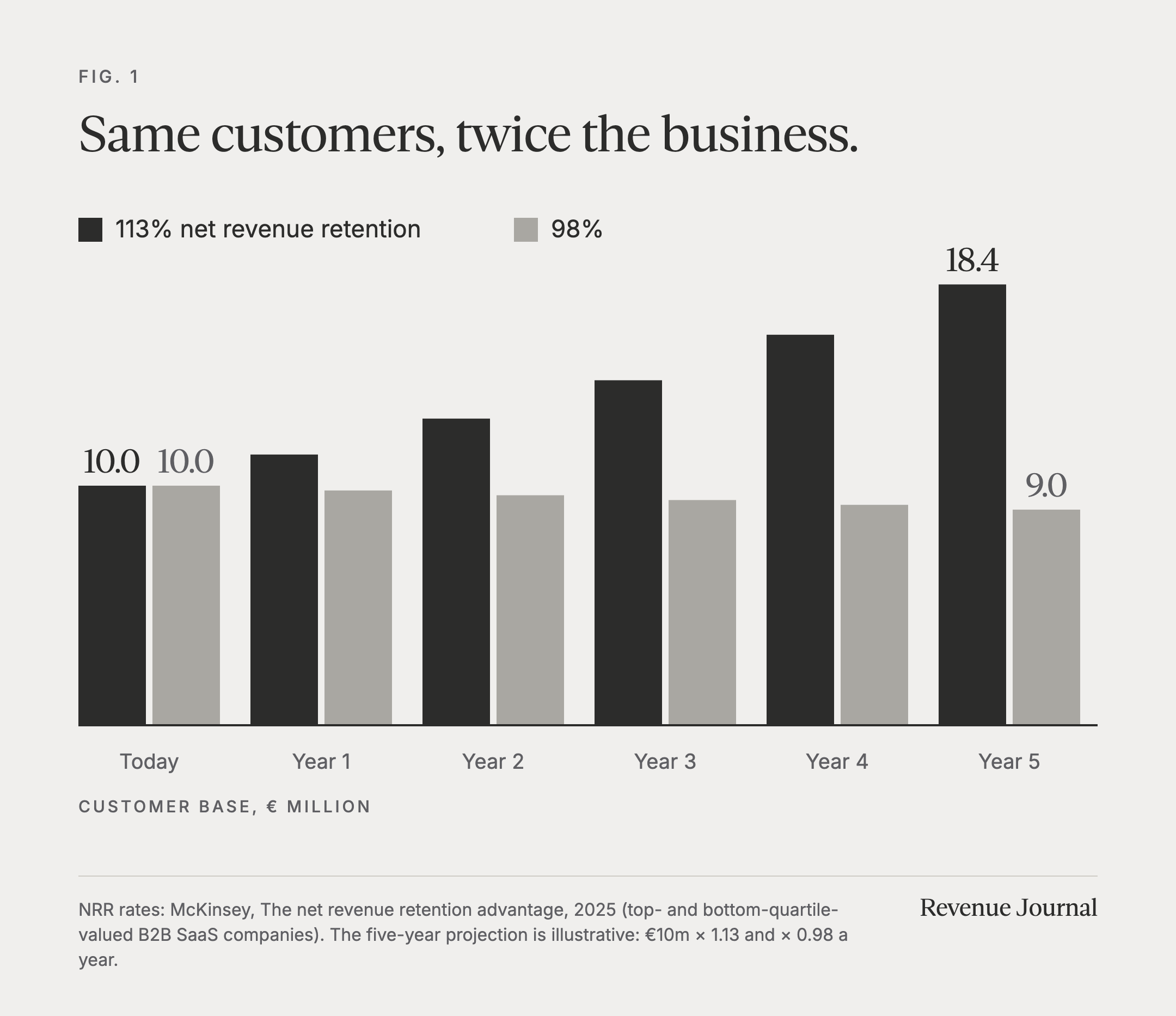
Most private software businesses sit nearer the middle. SaaS Capital’s 2025 survey puts median net revenue retention at 102% for companies with annual contract values of $25,000 to $50,000, and the bottom quartile at 97% (SaaS Capital, 2025). One modest discount, applied across the renewing book, is the whole gap.
And the discount comes straight off profit, because the cost of serving a customer does not fall when their price does. On an account running at a 20% operating margin, a 10% renewal discount does not cost a tenth of the profit. It costs half.
Three renewal threats, and a discount answers none of them
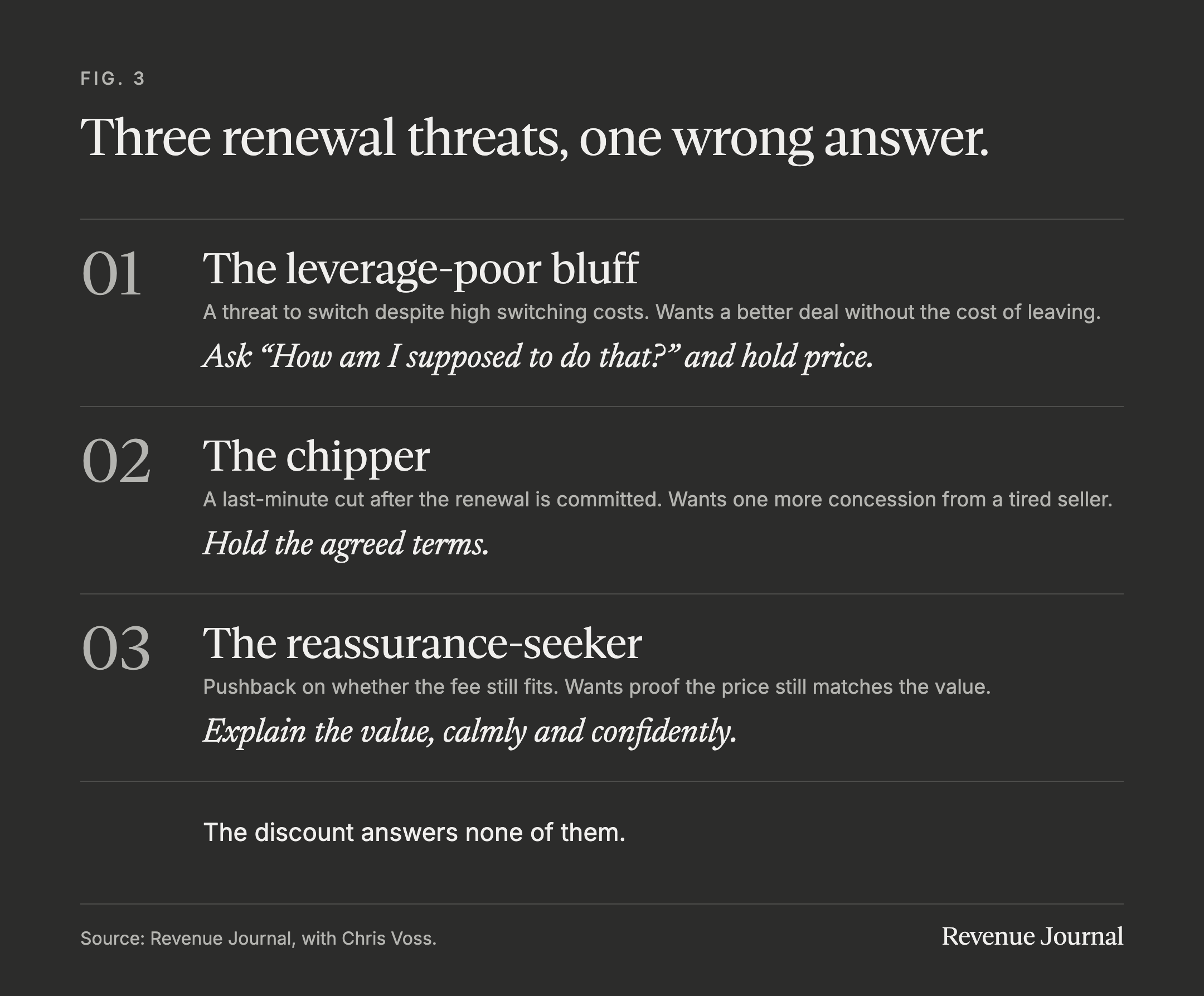
The discount treats every threat as the same problem: price. In my years managing renewals on large accounts, it rarely was. The threats I sat through fell into three types.
The leverage-poor bluff
Some customers threaten to leave precisely because their leverage is limited. They know as well as you do that leaving would be enormously expensive, and that nobody can promise the transition would succeed. Nowhere is that truer than in enterprise software, where the product is wired into how the business runs. The threat is a bet that you will flinch before they have to prove it.
Buyers are also stickier than their threats suggest. McKinsey’s 2024 B2B Pulse survey of more than 3,600 decision makers found 44% are relationship-oriented buyers who are slow to switch suppliers even when they are unhappy with the one they have (McKinsey, 2024).
The chipper
The chipper waits until the renewal is effectively committed, then comes back for one more cut. The paperwork is drafted, internal sign-off is done, the number is in your forecast. That is the point.
Anyone who has sold a house in the UK knows this as gazundering: the buyer cuts their offer on the eve of exchange, betting the seller is too far in to walk away.
It is a cynical technique that relies on exhaustion, usually the seller’s, sometimes the buyer’s own team’s. The rep who has spent weeks getting a renewal over the line would rather give away 5% than reopen the whole thing.
“It’s not a sin to not get the deal. It’s a sin to take a long time to not get the deal.” - Chris Voss
Their bet is that you will treat the time already spent as a reason to give more away. That time is gone either way. Paying for it with margin does not bring it back.
The reassurance-seeker
In my experience, this is the majority, and it is rarely a threat at all. The buyer simply wants to be shown that the fee they are paying is still relevant and right for what they receive.
We have all overpaid for something just because we have had it for a long time. Mortgages, utilities, gym memberships: entire business models rely on that inertia. Your customer knows those mechanics and does not want to discover they have been on the wrong end of them with you. The question underneath the pushback is rarely “can I get it cheaper?” It is “am I being taken for a ride?”
Gartner found 60% of technology buyers involved in renewal or expansion decisions regret nearly every purchase they make, mostly because of dysfunction inside their own buying team (Gartner, 2023). As Brent Adamson argued when we spoke to him, the trust gap sits on the customer’s side of the table: they do not trust themselves.
A discount leaves that question unanswered, and it can confirm the suspicion. If 15% comes off that easily, what exactly have they been paying for?
What answers it is value, explained calmly and confidently: what they pay, what they got, and why the two still match. McKinsey found that companies which systematically show customers what they are getting run net revenue retention around seven points higher than peers (McKinsey, 2025).
The clearest case I had was a large account I inherited from my predecessor, a customer of more than a decade. The contract was a shitshow: legacy clauses all over it, pricing models mixed together, and custom solutions priced years earlier on a basis we no longer had any way to explain. The customer wanted a discount. He felt they were paying a lot, and he could not defend the current state to his own business.
We had four months until renewal, with terms due 30 days before it. Rather than negotiate over the price, we cleared out every legacy contract and built a new one from scratch that showed exactly where the money was going.
He got a 5% reduction, matched to a real fall in the number of users they needed. We got a contract that could grow with the account. The old one was byzantine: a fixed fee for up to a set number of users, far more than the 120 in the system, worded so that we could not grow the account and they could not reduce their cost.
The price moved because the usage did, which is all a reassurance-seeker is asking for. That kind of mess builds up naturally in any long relationship, through changes to the business model, the product and the people on both sides. Clean it up, and the price conversation often goes with it.
One question sorts the bluff from the real threat
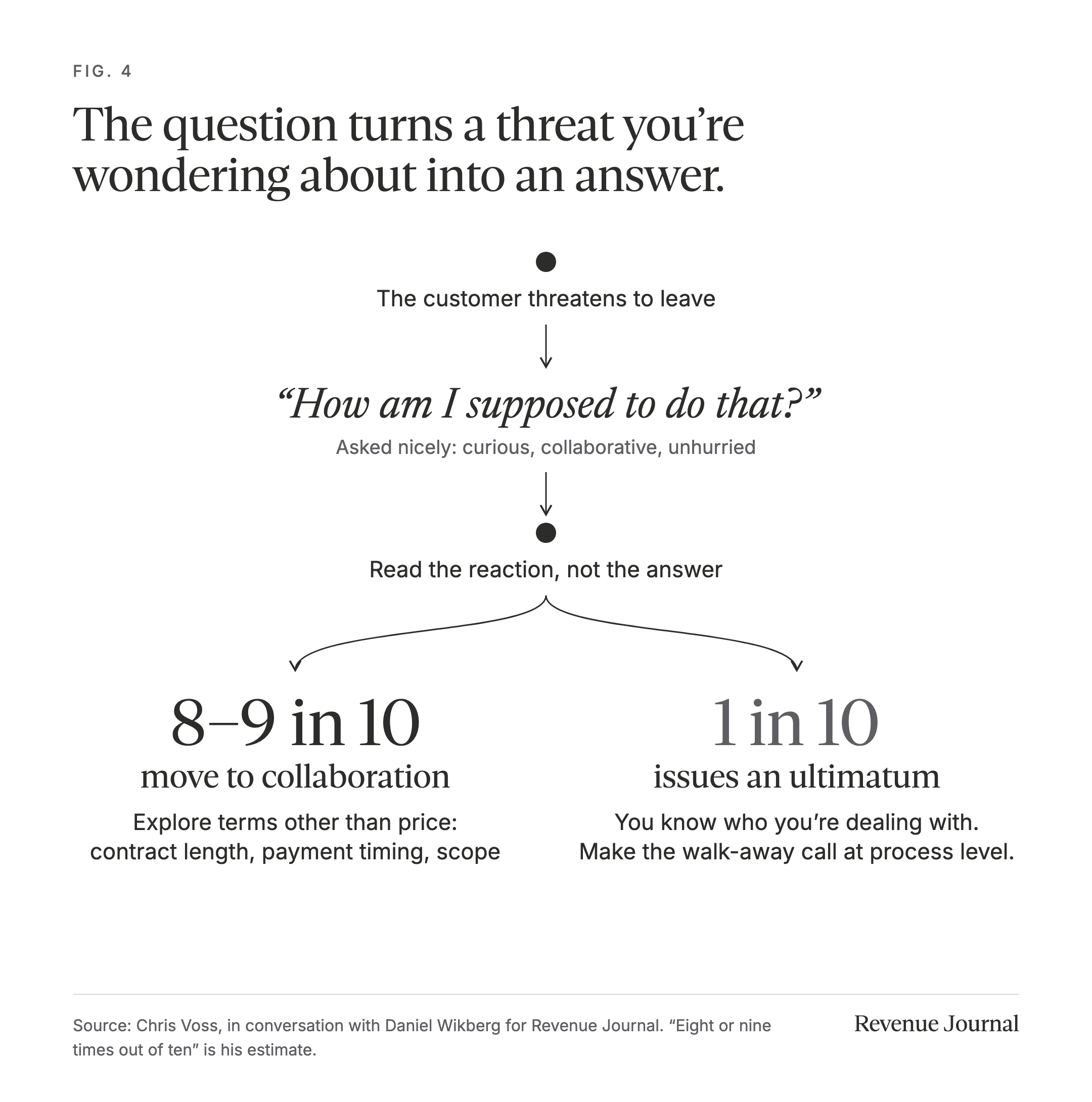
Voss’s answer to the renewal threat is a single question: “How am I supposed to do that?” How you ask it matters more than the words.
Not as an accusation. “I’m going to say it nicely,” Voss said. His son Brandon calls it forced empathy. It turns the customer’s attention to your constraints instead of only their own: “I want you to take a look at my position.”
Then comes the part most people miss.
“Now, your answer is secondary to your reaction.” - Chris Voss
The question exists to make the customer stop and think, in Voss’s words, that “there may be more here than meets the eye.” By his estimate, eight or nine times out of ten the customer softens, acknowledges there are real problems on your side, and starts solving them with you.
It only works if you have earned it. When a customer pushes to renegotiate, Voss says his first job is to “pass the test gently”: curious, collaborative, not angry in return. If the renewal quote is the first time the customer has heard from you all year, you have not earned the question.
The bluffer usually moves to collaboration, because they never planned to leave. The reassurance-seeker almost always does, because they wanted a conversation. If the pressure is real, Voss’s advice is to look at “other terms that maybe we could change other than price.” Contract length, payment timing and scope all come before the number.
Then there is the one in ten who says do it or I walk. “What just happened is you just gave me a clearer picture of who you are,” Voss said. To him, that is information.
“I got the bad news, but you’re always better off when you go from wondering to knowing.” - Chris Voss
Let the wrong ones walk
The damage from reflexive discounting rarely shows up where anyone is looking. A team that saves every logo with a concession can report near-perfect logo retention while revenue from existing customers quietly shrinks.
That one in ten is the customer to plan around, because, as Voss put it, “the best indicator of future behaviour is past behaviour.”
A customer who meets a reasonable question with an ultimatum will do it again at the next renewal, and the one after. “The customer that always makes life difficult always takes more time,” Voss said. His own team measured exactly that: difficult clients took two to five times as long to make the same profit. Keep them at a discount and you have paid twice.
Who makes the call is the hard part. A rep whose quarter depends on a renewal closing cannot be expected to walk away from it. Voss’s answer to Daniel’s final question applies to the organisation as much as the individual.
“Don’t take yourself hostage.” - Chris Voss
Don’t put yourself in a position where you cannot say no. A rep who cannot afford to lose the renewal has already conceded it. The walk-away decision belongs at process level, agreed before the call. JR Butler made the same argument about hiring: the longer you wait to act on a bad fit, the more it costs.
Diagnose first, discount last: the renewal negotiation playbook
- Start the value conversation months before renewal. If you cannot say what the customer got from you this year, neither can they. Surface concerns early with a label, Voss’s “it sounds like something’s bothering you,” while there is still time to fix the problem rather than price it.
- Lead with value, delivered calmly. For most customers this is the whole job. What they pay, what they received, why the two still match. Name the doubt before they do, the way Voss opens a big number: “Look, it’s a lot. I’m asking a lot.”
- When the threat comes, ask the question. “How am I supposed to do that?” Collaborative, curious, unhurried. Then watch the reaction, not the answer.
- Trade terms before price. If the pressure is genuine, explore everything else first. A discount is the last lever, not the opening move.
- Hold agreed terms. When a chipper reopens a committed renewal, the time already spent is not a reason to concede. Say so, politely, and wait.
- Decide in advance who you will let walk. Agree the walk-away criteria, and who owns the call, before renewal season starts. Take the decision away from the person whose number depends on it.
So the next time a customer mentions they have been looking at alternatives, leave the discount where it is. Ask the question, read the reaction, and work out which of the three you are facing. Most renewal threats are a reasonable question. Fail to answer it, and no discount will be big enough.
Frequently Asked Questions
How should you respond when a customer threatens to leave at renewal?
Diagnose before you concede. Chris Voss recommends asking “how am I supposed to do that?” in a calm, collaborative tone, then paying attention to the customer’s reaction rather than their answer. By his estimate, eight or nine times out of ten the customer moves towards solving the problem with you. The minority who respond with an ultimatum have told you how every future renewal is likely to go.
Should you offer a discount to save a B2B renewal?
Rarely as a first move. A renewal discount comes straight off profit, because the cost of serving the account does not fall with the price: on a 20% operating margin, a 10% discount erases half the account’s profit. McKinsey found B2B tech companies with best-in-class pricing practices, including firm limits on discounting, run net revenue retention around 16 points higher than peers (McKinsey, 2025). Trade other terms, such as contract length or payment timing, before price.
Why do B2B customers push back on price at renewal?
Most want reassurance that the fee still matches the value they receive, not a lower price. Buyers are wary of the inertia pricing they know from mortgages, utilities and memberships. Gartner found 60% of technology buyers involved in renewal decisions regret nearly every purchase they make, largely because of dysfunction within their own buying team (Gartner, 2023).
What is a chipper in B2B renewal negotiation?
A chipper is a buyer who asks for a last-minute price cut after a renewal is effectively committed. The tactic relies on the seller’s exhaustion and reluctance to reopen a deal that is already in the forecast. The best defence is to treat time already invested as irrelevant to the decision and hold the agreed terms.
What does “how am I supposed to do that?” mean in negotiation?
It is a calibrated question Chris Voss uses to make the other side consider your constraints. His son Brandon calls it forced empathy. Asked collaboratively rather than as an accusation, it prompts most counterparts to move from demands to problem-solving, and reveals the few who will not.
Contributors
Daniel Wikberg is CEO and Founder of Aira and Upsales. He has spent 20+ years building B2B sales technology, scaling Upsales to a Nasdaq First North listing. linkedin.com/in/danielwikberg
Chris Voss is founder and CEO of the Black Swan Group and author of Never Split the Difference. He served as the FBI's lead international hostage negotiator and now teaches business negotiation globally. blackswanltd.com
About Revenue Journal
Revenue Journal is where B2B executives share first-hand growth strategies and hard-won insights. Published by Aira. www.aira.app/blog | www.aira.app/events