In brief:
Brent Adamson co-authored The Challenger Sale, one of the most influential B2B sales books of the last two decades. In this conversation, he argues that the approach he helped create is no longer sufficient. Thought leadership has been commoditised. Buyers are not struggling to understand what to buy. They are struggling to make a decision at all. The new opportunity for differentiation is not saying something smarter. It is helping buyers navigate the complexity of their own buying process. Adamson calls this frame making. His research at Gartner shows that buyers with high decision confidence are 157% as likely to complete a high-quality, low-regret deal, and that sensemaking reps close premium deals at nearly three times the rate of reps who simply provide more information (Gartner/HBR, 2019).
In conversation with Brent Adamson: the man who wrote The Challenger Sale says it is no longer enough
The Challenger Sale was the first book I was given when I became a salesperson. I have read it three times since. I have recommended it to every sales rep I have ever worked with. It changed how I thought about what professional selling actually is. Not a personality trait. A craft. Something you can study, practice, and get better at.
So when Brent Adamson sat down with us and started explaining why the approach he helped create is no longer sufficient, it piqued my interest.
Adamson does not do speculation. He communicates through bar charts. He spent over two decades at CEB and then Gartner, running large-scale quantitative research into how B2B organisations buy and sell. He co-authored The Challenger Sale, which changed how a generation of sales operators and leaders thought about differentiation. Then he watched the market absorb the lesson and commoditise it.
“I still have one or two people who are at 130% of goal, even in the face of the worst economic meltdown in recent memory...what the ‘bleep’ are they doing?”
The Challenger research started in the winter of 2008.
“The thing that made them scratch their heads was not ‘how do we meet our goals?’ It was: why is it that in this context, I can look at my sales team and I still have one or two people who are at a hundred and thirty percent of goal, even in the face of the worst possible economic meltdown in recent memory?
What they found upended the dominant sales methodology of the time.
“These challenger reps were not taking at face value whatever they got from the customer as the right answer. They were actually challenging customer’s assumptions and thinking about themselves as an organisation. They were leading to their unique strengths, not with their unique strengths. It took the narrative flow of an entire sales conversation and essentially stood it on its head.”
The conventional approach was simple: show up, identify a need, propose your solution. Challenger reps inverted that. They led with a different way for the customer to think about their own business. A missed cost. An underestimated risk. An opportunity they had not considered. The solution came last, not first.
Anyone who has sat through (or delivered) a features-and-benefits pitch knows why this worked. The buyer does not care about your product. They care about their business.
The key distinction: these reps were not challenging how the customer thought about the supplier. They were challenging how the customer thought about themselves. When you have had that conversation, you know the difference. The energy in the room changes.
It worked for two reasons. It was genuinely valuable. And nobody else was doing it. Differentiation through scarcity. Both conditions mattered.
Everyone became a thought leader. So nobody is.
In the early 2000s, most B2B companies differentiated on product. Our product is better, faster, cheaper than theirs. That window closed as the internet enabled ‘fast followers’ and commoditisation accelerated. Companies responded by bundling products into solutions: identify a challenge, light up an array of capabilities, sell one-plus-one-equals-three.
Everyone had the same idea at the same time. FedEx started with overnight air, UPS started with trucks and freight, but both wanted to be world-class global logistics companies. They spent a decade acquiring and building. By 2010, they both had planes, trucks, retail chains, and global networks. They had closed the differentiation window on one another.
“Companies were looking for a new way to differentiate, and the heart and soul of The Challenger Sale is this idea that it’s not what you sell that is your biggest opportunity for differentiation. It’s actually how you sell.”
Challenger landed at exactly the right moment. 2010. Solutions commoditised. A new surface area for differentiation was wide open. But then the same cycle repeated.
Around 2014, every CEO came to the same conclusion: we need to be a thought leader. Marketing built content strategies. The MarTech stack exploded. Better data fed better machines to distribute more content at greater scale. Adamson calls this the ‘smartness arms race’. It wasn’t just a volume problem.
“It’s not just a high quantity of information that’s out there. It’s a high quantity of high quality information, because it’s not just everybody saying things, everybody’s saying really smart things.”
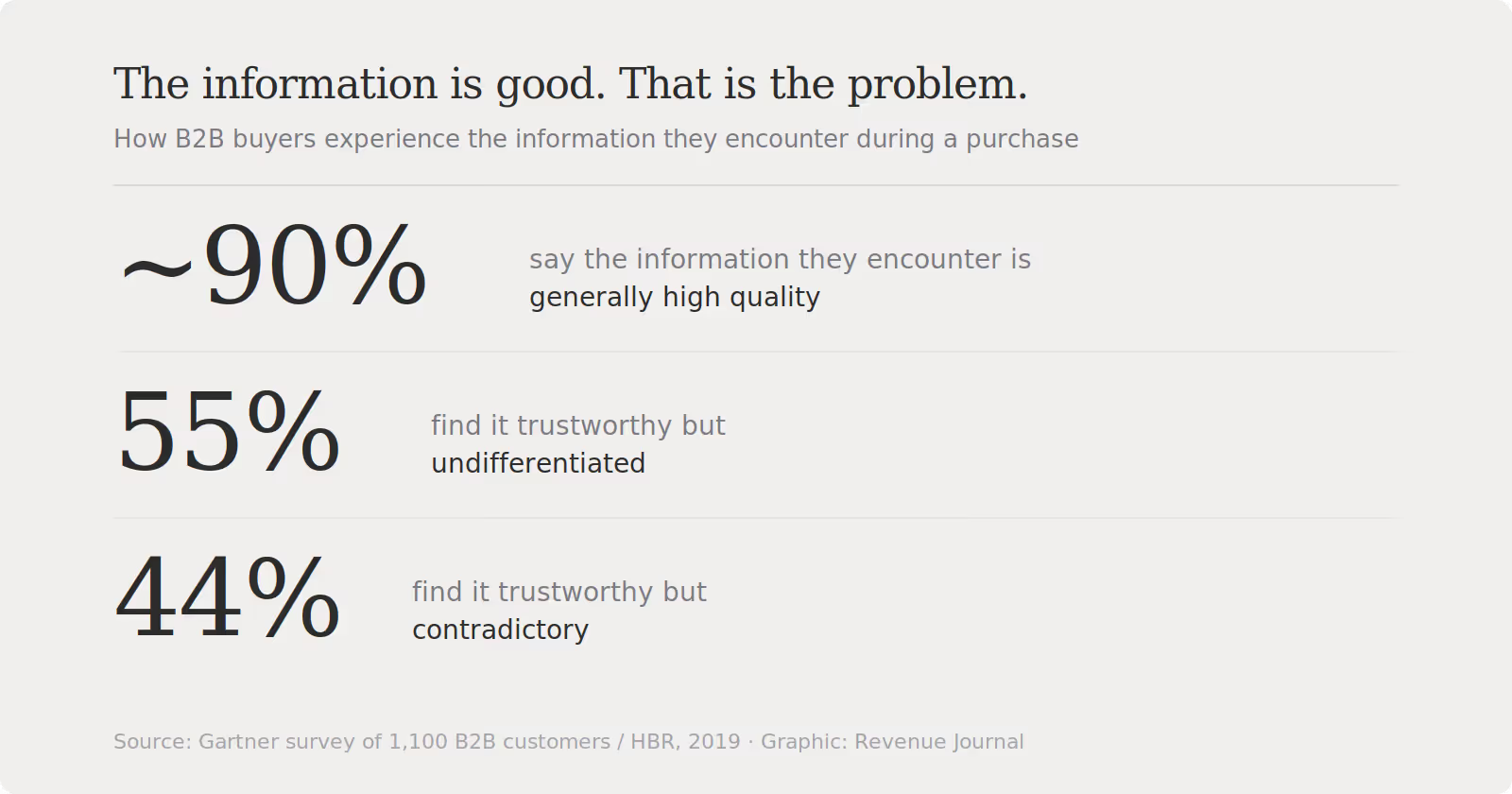
Gartner surveyed 1,100 B2B customers. Nearly 90% agreed the information they encounter during a purchase is high quality. But 55% found it undifferentiated. And 44% found it contradictory. The information is good. That is the problem (Gartner/HBR, 2019).
B2B customers now dedicate only 17% of their purchase process to talking with suppliers (Gartner/HBR, 2019). The rest is independent research. If all they find is more high-quality content pointing in every direction, your limited window of contact needs to do something other than add to the pile.
Adamson tells a story about a senior sales leader at a conference who raised his hand: “But Brent, I did what you told me to do. Our entire industry is telling everyone to zig and we’re challengers, so we’re telling everybody they need to zag. So we’re okay, right?”
Adamson’s answer: if everybody has evidence, the customer doesn’t know what to do. You are not losing to the competition. You are losing to the confusion.
We have all been in deals where the buyer went quiet, not because they chose a competitor. Because they chose nothing. That used to feel like a failure of persuasion, but Adamson is saying it is a failure of guidance.
“You can’t discover what isn’t there to begin with”
The conventional sales playbook assumes the buyer knows what they want and the seller’s job is to uncover it. Discovery calls. BANT. MEDDIC. All assume the customer has a defined problem, a budget, a timeline, and an internal process for making a decision.
That assumption is broken. If you have ever run a discovery call where the buyer’s answers shifted depending on who was in the room, you already know this to be true
“I don’t know that they know what their challenges are. Or at the very least, I don’t know whether all ten stakeholders of the purchase would agree that those are the challenges. You can’t discover something that’s actually not there to begin with. You have to go co-create this stuff.”
If a customer already has budget, authority, need, and a timeline,(BANT) you are arriving at established demand. They already know what they want. All they need to do is pick who is cheapest. You have walked straight into a bake-off. The qualification criteria we have been trained on were selecting for deals for which we didn’t have the highest opportunity of closing.
The four worst words in sales: “it turns out that.” It turns out procurement needs to review this. It turns out legal has questions. It turns out we need to involve the EMEA team. Each one is the customer telling you they do not know how to navigate their own buying process.
We covered a related dynamic in our conversation with Chris Voss, where he argued that deals are lost much earlier than the close, when critical information stays hidden. Adamson is making a structural version of the same point. The information is not hidden. It does not exist yet. The buyer has not done the internal work to create it.
More information is not the answer
Adamson published a piece in HBR on information strategies for sales reps. He identified three approaches. Most of us have used all three, which is what makes his data uncomfortable.
Giving is indiscriminate generosity. White papers, ROI calculators, competitive comparisons. The customer is already drowning. More does not help. Telling is the experienced rep who says: I have been doing this for thirty years, here is what you need to do. In a world where the buyer can check your opinion against twelve other sources, that is not helpful. More often than not it pisses them off.
Giving is such an easy trap to fall into. Adamson talks about ‘the customer is always right’ being hard coded into how reps think, and it is obvious why. The customer can always walk away and find another vendor. The rep doesn’t have the same luxury. With potentially months invested in a sales process, dozens of touch points, many pipe reviews discussing the deal with your management, and maybe even a ‘commit’ given, it’s all too easy to fall into a pattern of appeasing the customer, rather than challenging or guiding them.
Sense making is different. The rep says: there is a lot of information out there. Let me help you put a framework around it. Here are the two or three things you need to read. Here are the questions to ask yourself as you read them. I am not telling you what to think. I am making the world smaller and manageable so you can come to your own conclusions.
“It’s kind of like why we hire travel agents. I’m trying to book a trip, and there’s so many variables. Just help me. Like, what are even the questions I should be asking?”
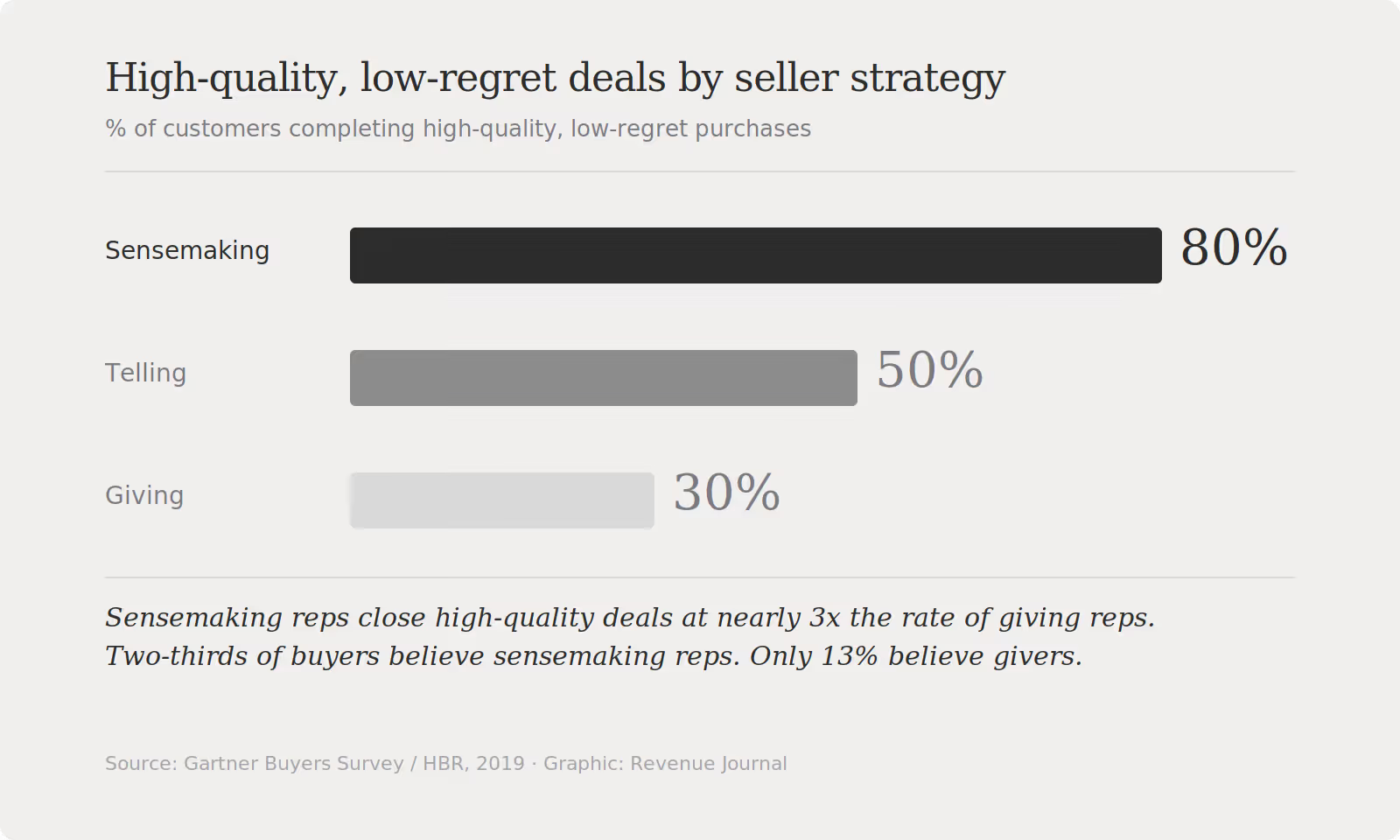
80% of customers with sensemaking reps completed high-quality, low-regret purchases. With telling reps, 50%. With giving reps, 30%. Two-thirds of buyers believed sensemaking reps. Only 13% believed givers (Gartner/HBR, 2019). Sensemaking reps close premium deals at nearly three times the rate of reps who just add more information to the pile.
Stop teaching. Start helping.
So what comes after Challenger? Adamson calls it frame making. Where Challenger taught reps to reframe how customers think about their problems, frame making helps customers navigate the buying process itself. Sense making for information. Value framing for priorities: getting ten stakeholders to agree on the objective, the metric, the target, the timeline. Decision framing for the process: proactively warning buyers what will blow up their deal and how other companies have handled it.
Not insight. Not thought leadership. Just reducing the friction of a process that is, by every measure, awful.
“I’ve asked thousands and thousands of people to give me one word, one adjective to describe a recent buying experience in their own company, and not a single one of those words has been positive.”
One point easy to miss: this is not an individual rep skill problem. It is an organisational capability problem. Mapping common deal-breakers, developing alignment frameworks, building the sensemaking toolkit: that is work for ops and enablement. Management’s job is to package it and coach reps to deploy it. Sending five hundred reps out to each build their own framework is a disaster. The teams that win are not the ones with the most reps. They are the ones with the best systems.
“It’s not that your customers don’t trust you. It’s that they don’t trust themselves”
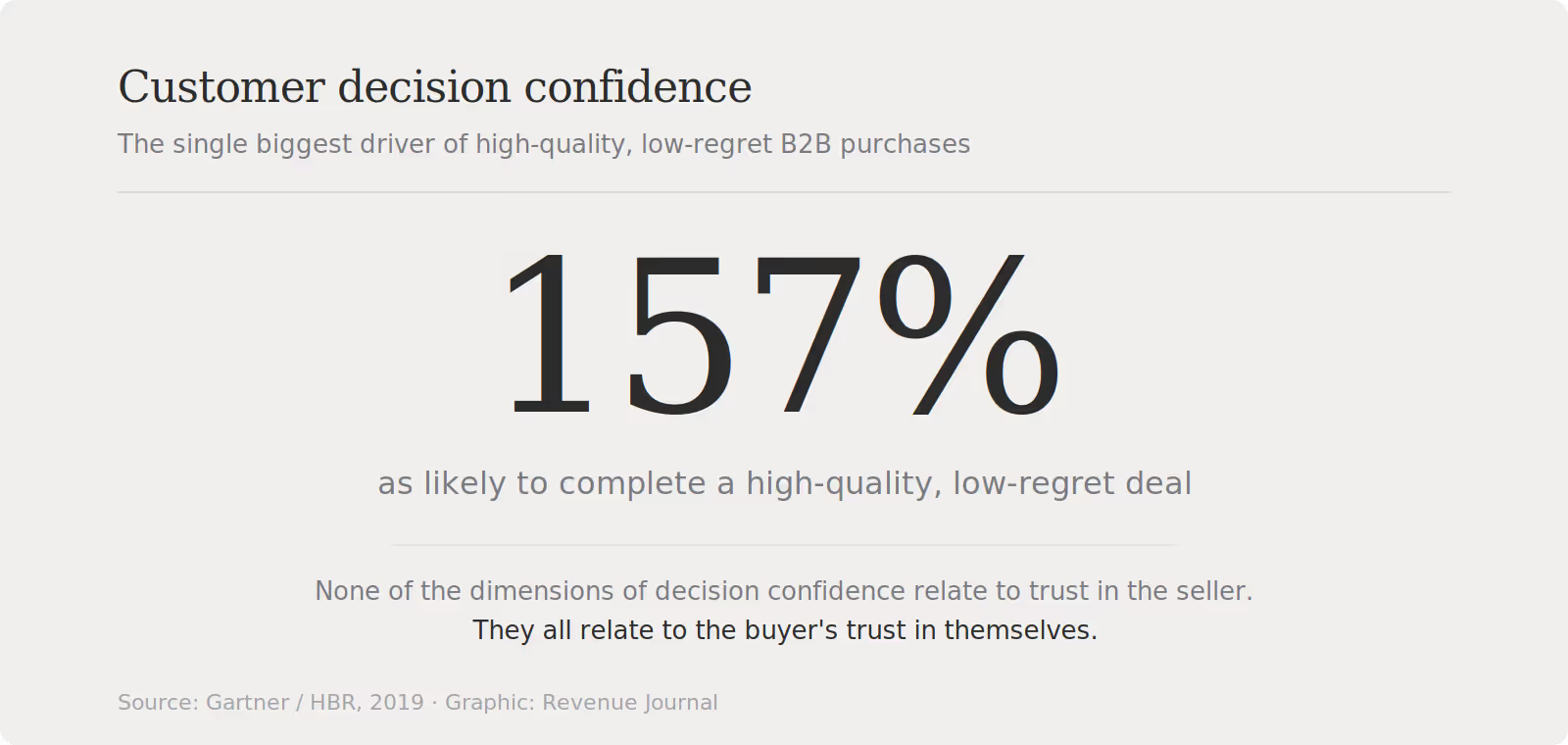
Of everything Gartner measured, one factor predicted deal quality above all others. Not brand trust. Not product quality. Not price. Customer decision confidence.
In practice: did we ask the right questions? Did we do enough research? Have we considered the right alternatives? Are we aligned internally? Can we implement what we buy? That is decision confidence. None of those dimensions are about you. They are all about the buyer. And buyers with high decision confidence are 157% as likely to complete a high-quality deal (Gartner/HBR, 2019).
“We talk all the time about being a trusted advisor. It’s not that your customers don’t trust you. It’s that your customers don’t trust themselves and their ability to make this kind of decision. And that’s what we’ve got to solve for.”
We spend enormous energy building trust in our product, our brand, our team, but the trust deficit is on the other side of the table. And the cost is measurable. A confused buyer is a lost buyer. Overwhelmed by information: 54% less likely to make a high-quality purchase. Contradictory information: 66% less likely. Conflicting trade-offs between suppliers: 33% less likely. The effects stack. If your buyer hits two of those three conditions, you have effectively halved your chance of closing a premium deal (Gartner/HBR, 2019).
There is a line from Cialdini that Adamson keeps coming back to. The people we want to spend time with are not just the people we like. They are the people who make us like ourselves better when we are around them. Applied to sales: be the company that makes the buyer feel competent, not dependent. Even if you lose, you become the first call next time. Adamson quotes Brian Smith, CEO of Expedient: “Our job is to help our customers make the best decision possible in as little time as possible.” If you lose, lose early. But be the company that showed up differently.
You can do everything right and still lose the deal. That will always be the case. But the buyer who was guided through the process is more likely to make a decision at all, and more likely to trust the company that helped them make it. It is worth coming back to Adamson's central argument: most deals are lost to confusion, not competition. There will always be buyers who treat a sales process as a commodity comparison, and those are not the ones you can influence with anything but price and features. The buyers looking for a strategic partnership will work with someone they trust. Be that someone.
A whiteboard and an honest conversation
Three starting points. None require a budget or a six-month implementation.
First, the “it turns out that” audit. Get your sales team in a room with a whiteboard. What are the four things that derail deals that customers themselves had not expected? Write them down. Then: how can we warn buyers these are coming? Twenty percent of the work for eighty percent of the value.
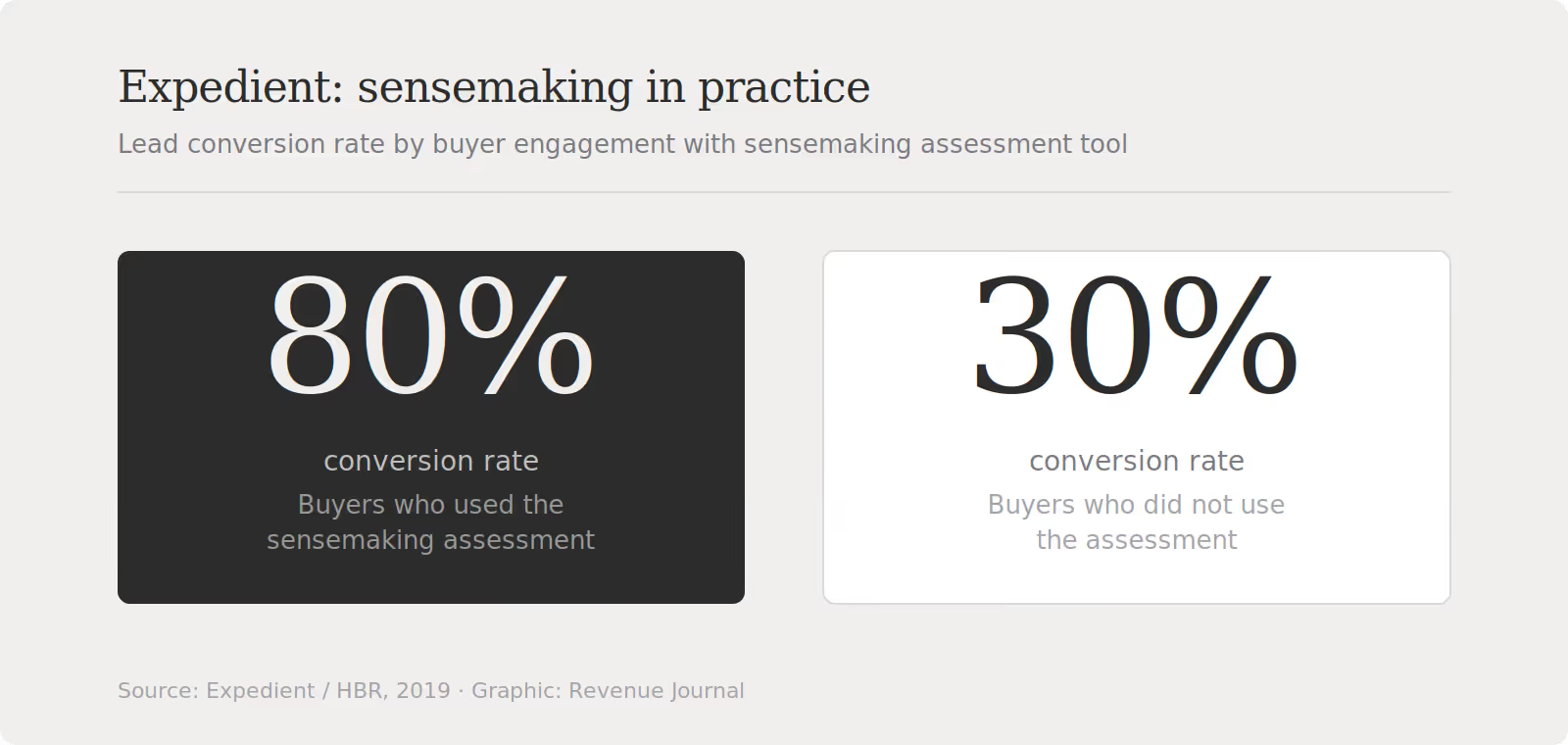
Second, map what your buyers are reading. What competitor content are they consuming? Then help them make sense of it rather than competing with it. In his HBR article, Adamson profiles Expedient, a mid-market cloud company competing against Amazon, Oracle, Microsoft, and IBM. They discovered all their prospects were watching a competitor’s video series. Rather than building competing content, they recommended the competitor’s videos alongside three questions to consider while watching. They built a self-assessment tool that helps buyers evaluate their own situation rather than presenting Expedient’s assessment. Buyers who used it converted at 80%. Those who did not: 30% (HBR, 2019).
Third, stakeholder alignment. If three stakeholders say different things about their top priority, get them in a room. Help them agree on the objective, the metric, the target, the timeline. If they cannot agree on what they are trying to do, you cannot show them how you help.
Across all three, one phrase keeps coming back. Adamson recommends: “In working with other companies like you, we find that...” Not expert. Connector. The value is pattern recognition, not opinion.
Our take: the timeline has bent back on itself
Adamson presents this as linear. Product, solution, insight, framework. Each stage replaces the last. Having lived through most of this arc as a practitioner, I see it differently.
Too much information looks remarkably similar to too little information from the buyer’s side. In both cases, the buyer does not know what to do. In both cases, they need someone they trust to help them navigate.
That is relationship selling. Not the golf-and-dinners caricature. The real thing. A person who reduces your anxiety and makes you feel confident enough to act. Adamson’s contribution is to give that instinct a methodology. Frame making is relationship selling with a system attached.
The best sellers in 2008 helped buyers see what they were missing. The best sellers in 2026 help buyers see through the noise. Different problem, same skill.
“Just people struggling to make good decisions”
“You think these are rational B2B decisions about what’s good for shareholder value, but you scratch the surface and pull back the covers and you find it’s just people struggling to make good decisions, and it’s hard. And they’re just looking for help.”
Strip away the frameworks, the data, the twenty-year timeline, and what you are left with is a person sitting across from you who does not feel confident about the decision they are about to make. The rep who solves for that wins. Not because they are smarter. Because they are helpful.
I have sat across from that person hundreds of times. You probably have too. We just did not always know what we were looking at.
Frequently Asked Questions
What is frame making in B2B sales?
Frame making is a concept developed by Brent Adamson that describes helping B2B buyers structure their own decision-making process. It includes sense making (putting a framework around information), value framing (aligning stakeholders on priorities, metrics, and timelines), and decision framing (proactively identifying where deals typically go off the rails). The core idea is that the biggest barrier to B2B purchases is not the buyer’s confidence in the seller, but the buyer’s confidence in their own ability to make a good decision.
Is The Challenger Sale still relevant in 2026?
Yes, but it is no longer sufficient on its own. Adamson argues that the differentiation window Challenger opened has narrowed because thought leadership has been commoditised. Challenger’s core principle of leading to your strengths rather than with them still applies, but it needs to be deployed within a frame making approach that helps buyers navigate complexity, not just rethink assumptions.
What is customer decision confidence and why does it matter?
Customer decision confidence is the buyer’s belief that they have asked the right questions, done sufficient research, considered alternatives, aligned internally, and can implement what they buy. Buyers with high decision confidence are 157% as likely to complete a high-quality, low-regret deal. None of its dimensions relate to trust in the seller. They all relate to the buyer’s trust in themselves (Gartner/HBR, 2019).
How do you conduct an “it turns out that” audit?
Gather your sales team and identify the most common unexpected events that derail deals. Procurement reviews that appear late, legal concerns about compliance, stakeholders who surface after the process is underway. Document the top three or four patterns, then build proactive guidance that warns buyers these are coming and shows how other companies have handled them.
What is sense making and how is it different from thought leadership?
Sense making is an information strategy where the seller helps the buyer navigate the information they are already encountering, rather than adding more. Where thought leadership says “here is our smart take,” sense making says “here are the three things worth reading and here are the questions to ask yourself.” 80% of customers with sensemaking reps completed high-quality purchases, compared to 50% with telling reps and 30% with giving reps (Gartner/HBR, 2019).