IN BRIEF
Most sales leaders track activity because the deals that close tend to have plenty of it, and the best reps tend to be the busiest. That is correlation, not causation, and managing to it turns good teams into busy fools. Forrester found that 86% of B2B purchases stall, and the work that gets them moving again happens between meetings, on the customer's side, where no activity dashboard can see. Sales author Stephan Schiffman sat down with Aira CEO Daniel Wikberg to explain why managers are taught to enforce process rather than teach it. This piece sets out a three-rung ladder (activity, engagement, progress) and a way to run pipeline reviews around the only question that matters: what is the next step, and what does the customer need to do before it?
Every sales dashboard tells the same story. The deals that close have plenty of activity logged against them. The reps who hit their number make the most calls, send the most emails and book the most meetings. So sales leaders track activity, set targets for it, and chase the reps who fall short.
It is an easy relationship to understand. It is also mostly wrong.
Sales activity metrics measure what the rep does. They say almost nothing about what the customer has committed to. Manage towards them for long enough and you end up with a team of busy fools: full calendars, green dashboards, and deals that quietly go nowhere.
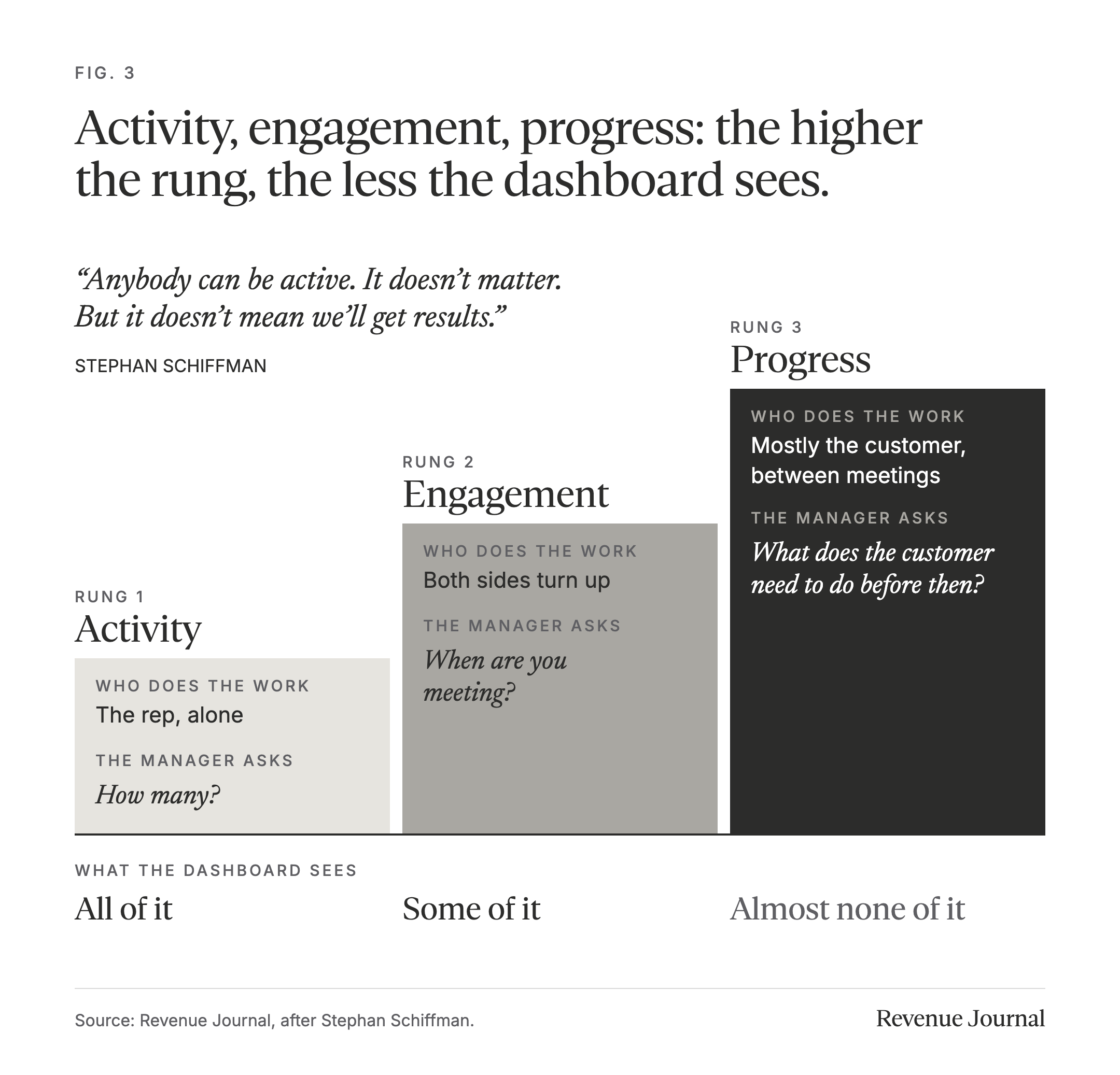
"Anybody can be active. It doesn't matter. But it doesn't mean we'll get results." - Stephan Schiffman
That is Stephan Schiffman, who has been training salespeople since he founded D.E.I. Management Group in 1979. His books, from Cold Calling Techniques (That Really Work!) to Getting to 'Closed', strip selling back to mechanics most teams have forgotten. When Aira CEO Daniel Wikberg sat down with him to ask why sales teams underdeliver, he did not blame the reps.
Deals don't die in meetings. They die between them.
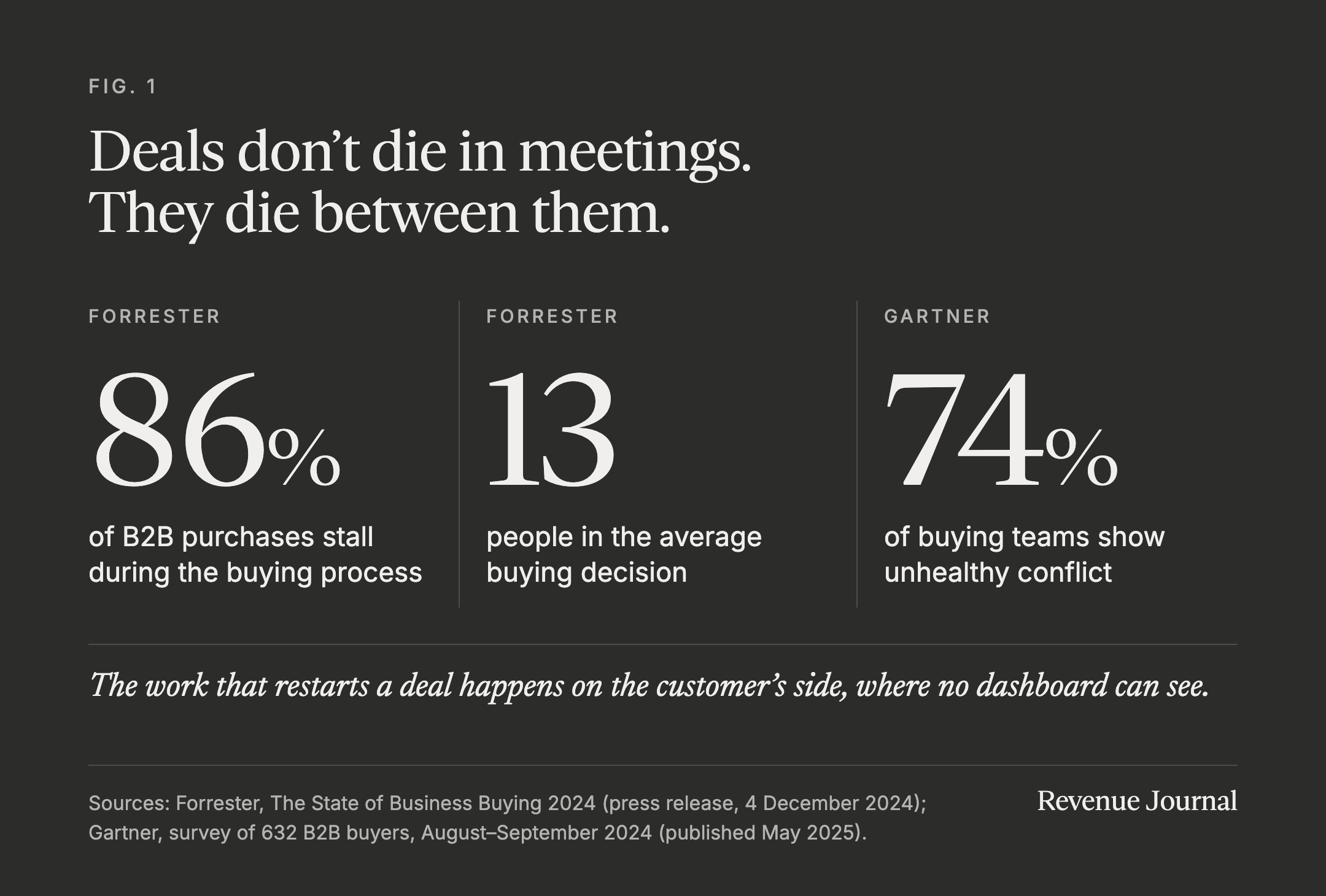
Most of the deals in your pipeline will stop moving at some point. Forrester's 2024 research found that 86% of B2B purchases stall during the buying process (Forrester, 2024). Not lost. Stalled.
The reason sits on the customer's side of the table. The average buying decision now involves 13 people, and 89% of purchases cut across two or more departments (Forrester, 2024). Each of those people has their own priorities, their own risks and their own veto.
Getting them to agree with one another is the part nobody plans for. Gartner found that 74% of B2B buying teams show unhealthy conflict during the decision, from clashing objectives to being overruled by someone outside the group (Gartner, 2025). Groups that do reach consensus are 2.5 times more likely to report a high-quality deal.
Do the arithmetic. If most deals stall, and the ones that move are the ones where a dozen people have aligned internally, then the work that decides your quarter happens in rooms you are not in. Your dashboard sees the call you logged on Tuesday. It does not see the finance director who has not yet been told the project exists.
Sales activity metrics have the relationship backwards
Top reps are not closing more because they are busier. They are busier because they have more live deals, and live deals generate work. Proposals to revise. Stakeholders to brief. Contracts to chase. The activity is a consequence of the pipeline, not the cause of it.
Push a struggling rep to match those levels and you get the motion without the deals. More follow-ups with nothing to follow up on. The dashboard turns green, but the forecast doesn't move.
That does not make activity worthless. A rep who makes no calls books no meetings, and volume still matters where the job is to start conversations. The mistake is carrying that logic into the rest of the pipeline, where the job is to move deals forward.
The root cause, in Schiffman's view, sits with management. "Managers are taught how to enforce a process, but they're not necessarily taught how to teach the process." Telling a rep to make more calls is enforcement. It produces activity, not results.
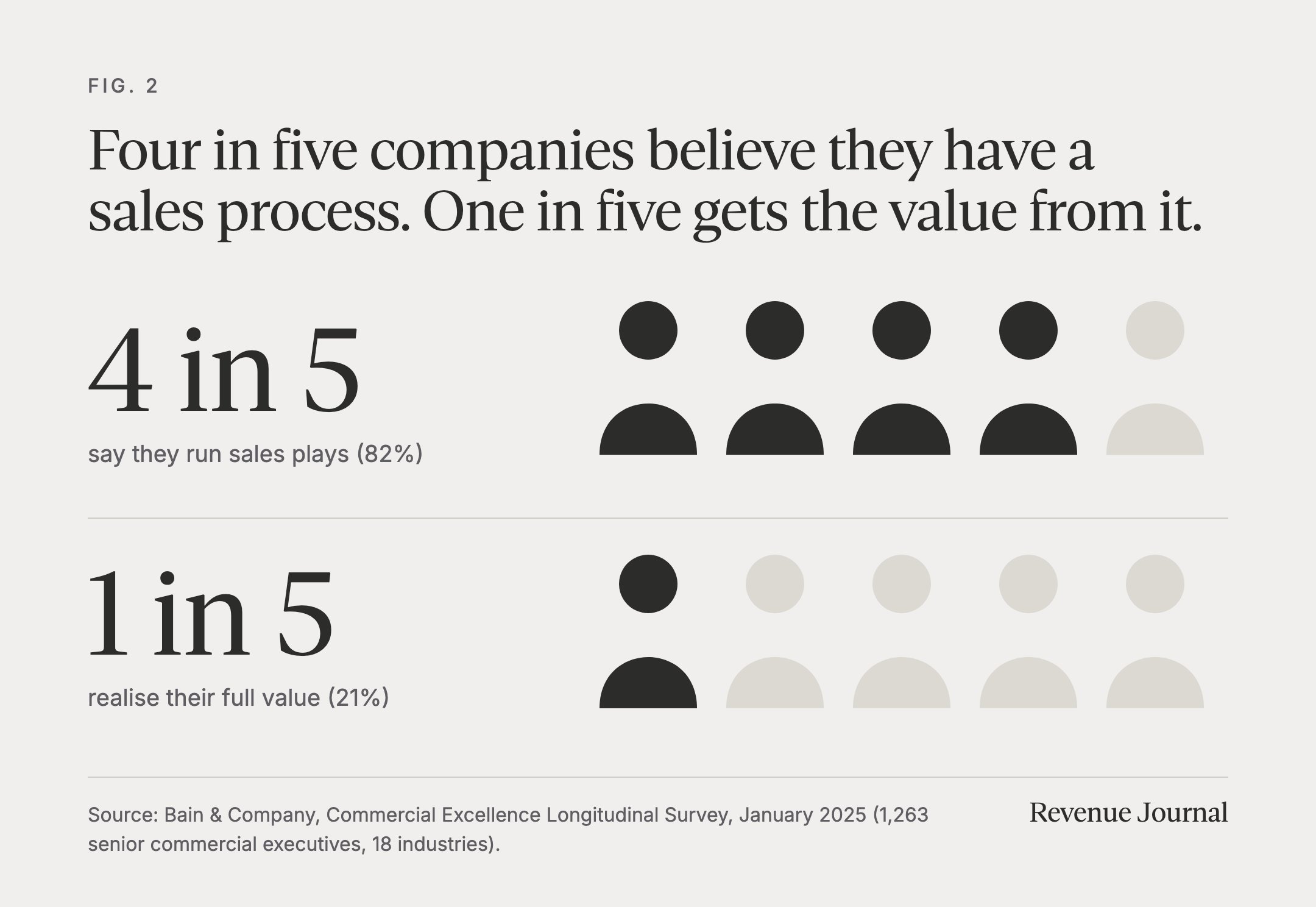
Systems share the blame. Bain surveyed more than 1,200 senior commercial executives: 82% said they run structured sales plays, but only 21% realise their full value, and 70% have not properly built those plays into their CRM and revenue technology (Bain, 2025). Four in five companies believe they have a process. One in five gets the value from it. As we argued in our piece on the AI sales performance gap, tools amplify the habits a team already has. Dashboards are no different.
One revenue operations leader quoted in McKinsey's 2026 research on B2B sales describes their company moving the sales manager "from performance inspector to sales coach" (McKinsey, 2026). Too many teams are still running the other way. Managing from a dashboard is like scrolling workout videos on Instagram. It feels like progress. It isn't exercise. Dashboards have replaced management.
Every meeting has to earn the next one
Sales, in Schiffman's words, is just getting to the next step. And a next step is only real if the customer is part of it.
"If you're saying to yourself, I'm going to go see them next Tuesday, and they're not ready to participate, it's not going to happen. It's your dream. It's your fantasy. It's not their fantasy." - Stephan Schiffman
"I'll call them next week" is not a next step if they do not know about it.
I would add one rung. A meeting in the customer's diary is engagement, not progress. Progress is when the customer leaves with enough value, and enough clarity about what they need to do next, that they commit to the next step on a short timeline.
I learned this the hard way. When I moved from SDR to my first AE role, I started taking meetings straight away. The coaching focused almost entirely on the first meeting. Qualify for time. Establish BANT. Get an honest reaction on price. Book a firm next step. Almost nothing covered what either side would do before that next step.
Plenty of my deals stalled. The ones that progressed were often inbound leads who were going to buy regardless. The advice from management was to call and follow up. Follow up what?
I have been on the other end of that call plenty of times. A supplier rings to check on progress when nobody ever agreed what progress would look like. Embarrassingly, I have ducked those calls myself. So why did I expect my own prospects to behave any differently?
I had it the wrong way round. I thought the meetings were where the work got done. Meetings are progress checks and planning sessions. The work happens between them, and most of it is done by the customer. Who else internally has a stake? Are there requirements they have not uncovered yet? Have they bought something like this before, and did it go wrong? What is the budget? Would they rather pay more to avoid being locked in, or take longer terms for the lowest price?
Customers have to work all of that out before they can sign, and often they do not know they need to do half of it. Buyers are rarely short of information, as Brent Adamson told us in our conversation on frame making. They are short of confidence in their own process. Leave them to it and the deal stalls.
My experience was not unusual. Bain found that 49% of companies focus their sales enablement primarily on new hires, while only 29% emphasise tenured sellers (Bain, 2026). Reps get taught how to open. Far fewer get taught how to keep a deal moving. It's like a driving test that ends once you've pulled out of the test centre car park. You've proved you can get the car onto the road. Nobody has checked whether you can get anywhere.
MEDDICC helps, because it forces the questions that matter between meetings. But a filled-in champion field is not a champion, a distinction we unpacked in our conversation with John McMahon. The framework works as a conversation, not as data entry.
"This is not a rally. It's a discussion of strategy."
That was how Schiffman ran Monday mornings with his team of 20 reps. No round of updates, which he says does not produce anything. Instead they went through every prospect, step by step, until "you could hear where the problem was."
Is there a next meeting? Will the right person be in it? Is there a schedule? Those questions surface a stalled deal in minutes. Compare the meeting most reps will recognise.
"Sales manager typically says, how are we doing? Hey, doing great. Okay, good. Good for you. Keep going. That's it." - Stephan Schiffman
The same conclusion turns up in McKinsey's 2026 research: one-on-ones and deal reviews should focus on what to do next, not just on what happened (McKinsey, 2026).
Ask Schiffman about micromanagement and he dismisses the word as overused. As a manager he walked the floor, listened to calls and picked up the phone with his reps. When a rep missed someone, they called back together, there and then. A call from the manager, he argues, is a different conversation.
"The rep fails, but they don't ask for help. And the manager fails because they don't offer it." - Stephan Schiffman
Reps rarely ask their manager to join a call. Managers rarely offer. None of it shows up on a dashboard. All of it moves deals.
The rep pays for the manager's silence
Managers have become afraid to critique, Schiffman argues, and reps are worse off for it.
"The salesperson doesn't get direction because no one critiques. We don't talk about directness anymore." - Stephan Schiffman
Daniel thinks it is worse in Sweden. "Here we are very afraid of saying anything."
This is not nostalgia for tougher management. A dashboard lets a manager avoid the hard conversation. Pointing at a red activity number feels safer than telling someone their biggest deal is dead, or that their discovery calls are not landing. Only one of those helps them hit their number.
Nearly half of Gen Z reps, 46%, rarely get feedback on their sales conversations (Salesforce, 2026). Not their activity. Their conversations.
Coachability, JR Butler told us, is one of the hardest traits to find in a sales hire. It is wasted if nobody is doing the coaching.
How should sales managers run a pipeline review?
None of this needs new software. It needs a manager doing the job differently on Monday morning.
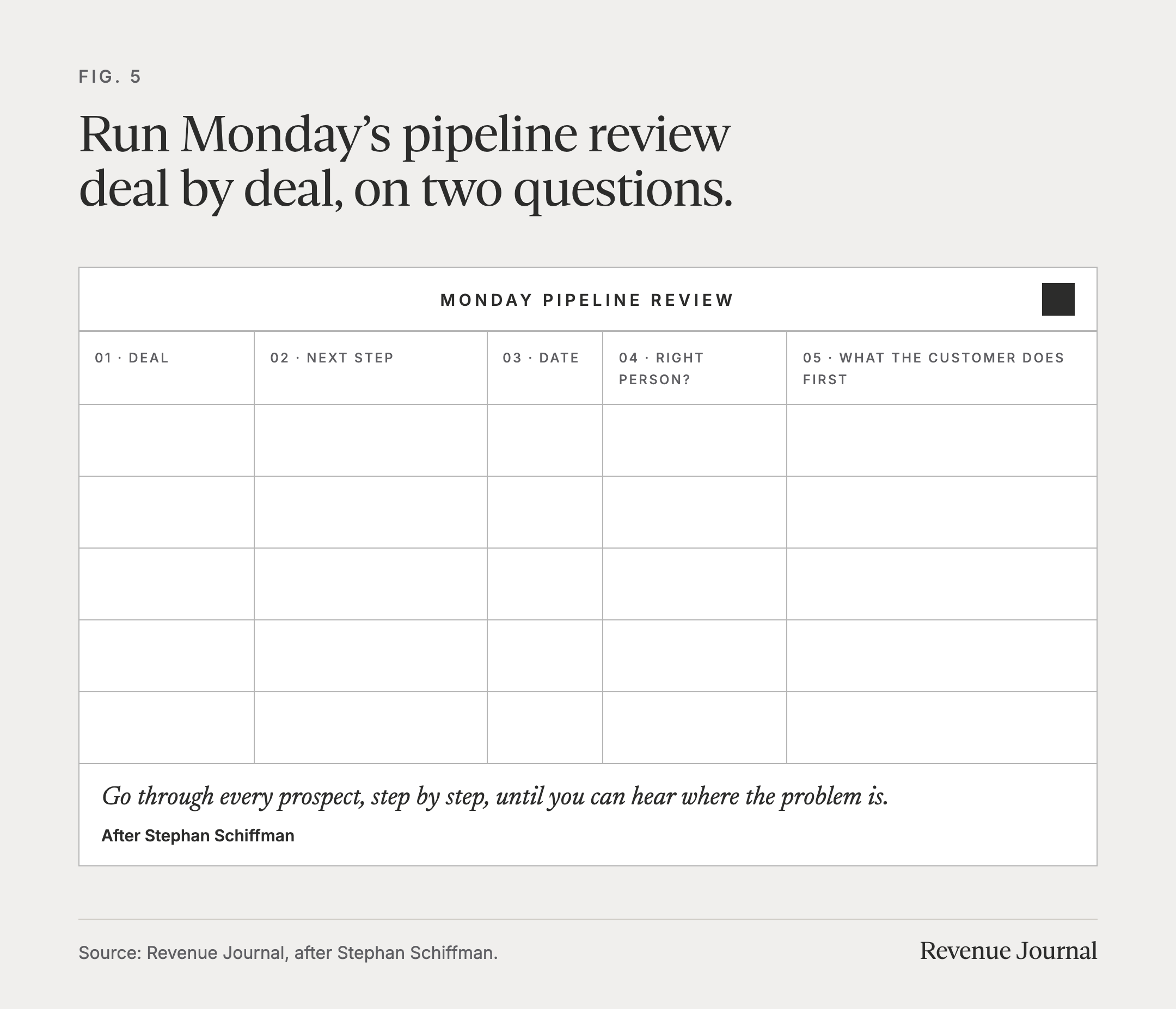
Ask two questions, not one. Replace "how's it going?" with: what is the next step, and what does the customer need to do before it? If the rep cannot answer the second, the deal is not moving, whatever the activity log says.
Track what the customer does. Calls and emails show effort. Meetings with the right people, agreed actions and dates the customer has committed to show movement.
Check what the last meeting gave the customer. If nothing of value came out of it, they have no reason to accept the next one quickly. Coach reps to leave every meeting with actions on both sides.
Diagnose fast. Schiffman's early-warning test looks like an activity metric, but it sits on the second rung, because a new meeting needs the customer to say yes. "If there are no new appointments today, then at the end of the sales cycle, let's say 90 days, there's no new sales. So you don't have to wait 90 days. You just have to wait two weeks."
Get on the call. Offer to join. Ask your reps to bring you in, and mean it.
Ask the MEDDICC questions out loud. They belong in the deal review, not just in the CRM.
Activity is easy to count, which is exactly why it gets managed. Progress happens between meetings, in conversations the rep is not part of, and it only surfaces when a manager asks the right question.
Sales activity metrics will tell you who is busy. They will not tell you who is selling. That takes a manager.
Frequently Asked Questions
Do sales activity metrics predict sales performance?
Activity correlates with results, but mostly because top reps have more live deals, and live deals generate work. The relationship largely runs from pipeline to activity, not the other way round. Pushing struggling reps to hit activity targets tends to produce motion without deals, so managers are better off tracking signals the customer takes part in.
What is the difference between sales activity and deal progress?
Activity is what the rep does alone: calls, emails and logged tasks. Engagement is the customer showing up to a meeting. Progress is the customer committing to a next step on a short timeline, with clear actions on both sides, and most of that work happens on the customer's side between meetings.
Why do B2B deals stall?
Forrester found that 86% of B2B purchases stall at some point, and the average buying decision involves 13 people. Gartner found that 74% of buying teams show unhealthy conflict during the decision. Deals stall when buyers cannot align internally or do not know what they need to work out, which is why sellers who guide the buyer between meetings keep deals moving.
How should a sales manager run a pipeline review?
Go deal by deal and ask two questions: what is the next step, and what does the customer need to do before it? Stephan Schiffman ran his Monday meetings this way with a team of 20 reps, because problems become audible when every prospect is discussed step by step. A review that only asks "how's it going?" produces reassurance, not results.
How quickly can you tell if a new sales rep is struggling?
Stephan Schiffman argues you can tell within two weeks by looking at new meetings booked. If a rep is not booking new meetings today, there will be no new sales at the end of a 90-day sales cycle. Waiting for the revenue number to confirm it wastes most of a quarter.
Contributors
Daniel Wikberg is CEO and Founder of Aira. He founded Upsales and has spent more than 20 years building B2B sales technology. linkedin.com/in/danielwikberg
Stephan Schiffman founded D.E.I. Management Group in 1979. He is the author of Cold Calling Techniques (That Really Work!) and Getting to 'Closed'. According to his publishers, he has trained more than half a million salespeople.
About Revenue Journal
Revenue Journal is where B2B executives share first-hand growth strategies and hard-won insights. Published by Aira. www.aira.app/revenue-journal