Most sales leaders believe AI is a great equaliser. Give every rep the same tools, close the gap between your stars and your stragglers. It's a comfortable idea. The data says otherwise. And the mechanism driving that is hiding in plain sight.
AI is not closing the performance gap in B2B sales teams. It is widening. Research shows just 14% of sellers already generate 80% of revenue, an 11x gap that existed before AI entered the picture. This article breaks down why top performers adopt AI readily while struggling reps retreat to familiar methods, and what sales leaders need to do about it. Including the decision most are avoiding.
70% of your team is already missing quota. AI won't fix that.
Start with the baseline. According to Ebsta's 2025 GTM Benchmarks Report, just 14% of sellers are responsible for generating 80% of revenue. That is an 11x performance difference between top and bottom performers. In a sales team of 20, roughly three people are carrying the target for everyone else.
This isn't a new problem. But it's getting worse. 69% of reps missed quota in 2024, with average attainment sitting at just 43% (Salesforce State of Sales, 2024). Most sales organisations are already running on a small engine. AI doesn't change the engine. It changes what happens when you put your foot down.
AI is a multiplier. Multiplying by zero still gives you zero.
Benedict Evans, a technology analyst who spent years as a partner at Andreessen Horowitz, put the question plainly at a recent event we hosted: "What happens if you make it much cheaper and more efficient to do something? Do you do the same amount of work with fewer people, or do you do more work with the same number of people?"
He was describing Jevons paradox. When the efficiency of a resource increases, total consumption tends to rise, not fall. Applied to sales: when AI gives a rep back three hours of their week, the question isn't whether they'll be more efficient. It's what they do with those three hours. And that depends entirely on which kind of rep they are.
In our experience working with B2B sales organisations, performance clusters around four traits: natural talent for selling, good use of available tools, personal organisation, and mindset. Top performers have all four. Your top rep today is already using every tool available, running structured days, and walking into every meeting prepared. Give them AI and they get sharper still: faster prep, better prospecting, tighter pipeline management. They reach output levels that simply weren't possible before. Average performers have two or three of those traits. The talented rep who was drowning in admin suddenly has time to sell. The organised rep without natural instinct suddenly has better conversations. This is the tier where AI genuinely does level things up.
Gartner found that sellers who effectively partner with AI are 3.7x more likely to hit quota (Gartner, 2024). That number is real, but it is not evenly distributed. It describes what happens to the reps who already have three of the four traits. For a struggling rep, the multiplier breaks down entirely. The core problem isn't time, or tooling, or information. It's mindset. And you cannot automate your way out of not wanting to pick up the phone.
The reps who need AI most are the least likely to use it
Here is the part that most AI rollout strategies ignore completely.
Across the organisations we work with, we see a consistent pattern when new tools are introduced: meeting notetakers, prep agents, web research tools, pipeline intelligence features. The uptake is never uniform. And it follows performance tiers almost exactly.
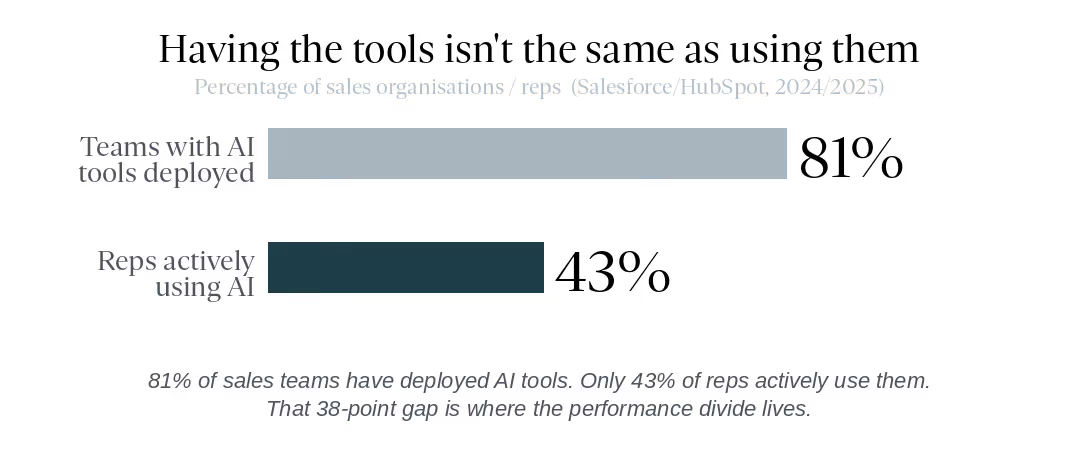
The data bears this out at scale. 81% of sales teams have deployed AI tools. Only 43% of reps actively use them (Salesforce/HubSpot, 2024/2025). That 38-point gap between organisational deployment and individual adoption is not a technology problem. It is a mindset problem in statistical form.
Top and above-average performers adopt quickly. They see the value immediately, experiment without friction, and build new habits within weeks. Struggling reps don't. They acknowledge the tools exist, open them once or twice, then quietly return to what they were doing before.
This isn't laziness. It's human psychology operating exactly as it should under pressure.
Research on stress and cognitive function is clear: prolonged pressure reduces our capacity for flexible thinking and makes us cling to familiar patterns, even when those patterns aren't working. A rep who has missed target for two consecutive quarters does not have the cognitive bandwidth to invest in learning a new workflow. The mental energy required to experiment is exactly the resource they've run out of. So they retreat to what feels safe: the call script they know, the outreach format they've used for years, the habits they're comfortable with. None of it is generating results. But it feels controllable in a way that a new tool does not.
There is a name for this in psychology: avoidance coping. Under stress, people default to behaviours that reduce immediate anxiety, even at the cost of longer-term outcomes. The struggling rep isn't making a bad decision. They're responding to pressure the same way most humans do.
The rep hitting 120% has an entirely different relationship with risk. They have the confidence, built on a track record of results, to absorb the short-term friction of learning something new. If a tool doesn't work perfectly in week one, it doesn't threaten their position. So they keep going. The compounding begins.
This is the contradiction at the heart of AI adoption in sales. The tool designed to close the gap will be self-selected by the people who least need it closed. Which means if you deploy AI across your team and simply wait for results, you already know what happens next.
Deploying tools without reading your team first is a decision with consequences
Most AI rollout strategies treat tool deployment as the intervention. Buy the licences, run the onboarding session, send the announcement, track adoption metrics. The assumption is that if you give people access, they'll figure out the value.
That assumption works for your top tier. It doesn't work for anyone else.
Rolling out AI without addressing the mindset gap in your lower tiers doesn't democratise performance. It concentrates it further. Your top reps get faster and more effective. Your struggling reps fall further behind and the gap widens. Worse, a rep who visibly ignores tools their colleagues are using daily sends a signal to the rest of the team. Disengagement is contagious in a way that enthusiasm rarely is.
Evans made a point at our event that applies here more than he may have intended: "AI is whatever we can't do yet. Because once it works, it's not AI anymore. It's just software." The reps who adapt first will stop thinking of it as AI. It becomes part of how they work, invisible and embedded. For the reps still on the sidelines, it will always feel like a burden. One more thing being asked of them on top of everything else that's already hard.
The psychology and the management implication are the same point. Reps without momentum don't take risks. Reps who don't take risks don't adopt new tools. Sales leaders who want AI to lift team-wide performance need to address the momentum problem first, not the technology problem.
Before the next rollout: read your team, then act on what you find
This is not a technology framework. It's a people audit.
Before any tool deployment, assess each rep honestly. Are they in a positive cycle: building momentum, hitting targets? Or a negative one? If it's the latter, what's driving it? A skills gap responds to training. A process gap responds to better tooling. A mindset problem requires a direct conversation about what is and isn't working, and whether there is a realistic path back.
Some of those conversations will produce a coaching plan and a rep who rebuilds. Others will make clear that the rep has neither the mindset nor the appetite to operate in the way the role now requires. That is also useful information. In an environment where AI literacy is becoming a baseline competency, a rep unwilling to engage with new tools is not just underperforming today. They are a structural liability. Their resistance drags on adoption across the team, and their disengagement sets a visible standard for what is tolerated. Sales leaders need to be honest about when coaching has run its course and an exit is the better outcome for everyone, including the rep.
For the middle tier, lead with your top performers and high-potential performers first. Let them become the internal proof of concept. When a struggling rep sees a colleague cut their meeting prep from 45 minutes to 10 and walk in better prepared, the argument for adoption becomes concrete. It moves from "the company wants us to use this" to "this is how the good people here work now."
For the bottom tier: be clear-eyed. Not every rep is salvageable in this environment, and carrying dead weight while your competitors field AI-enabled teams is a decision with consequences.
The performance gap in B2B sales was already stark. AI will make it starker for every organisation that treats it as a technology problem. For the organisations that are commercially honest about who is in their team first, it may finally be the thing that moves the middle of the curve.
We covered the tactical case for AI adoption in our earlier piece on how small sales teams are using AI to outrun enterprise competitors. The opportunity is real. But it only reaches teams that are honest about where they're starting from.
Frequently Asked Questions
Does AI improve performance for all sales reps equally?
No. AI functions as a performance multiplier. It amplifies what a rep already does well. Top performers with strong habits, the right mindset, and sales instincts see the greatest gains. Average performers with genuine talent but gaps in organisation or tooling also benefit meaningfully. Reps who lack the mindset are the least likely to adopt AI tools proactively, and therefore the least likely to improve without deliberate management intervention.
Why don't underperforming reps adopt AI tools even when they're available?
The barrier is psychological, not technical. Research on stress and cognitive function shows that people under sustained pressure default to familiar behaviours rather than experimenting with new approaches. A rep who has missed target for several quarters lacks the cognitive bandwidth to invest in learning a new workflow. This is avoidance coping: retreating to what feels controllable, even when it isn't working.
What should sales leaders do before rolling out AI tools?
Assess which reps have the mindset and confidence to actually adopt something new. For reps in a negative performance cycle, the priority is a direct conversation about what is and isn't working, not a new tool deployment. For reps who show no appetite to adapt, an exit may be the right outcome. A tiered rollout starting with high performers is more effective than a blanket deployment that widens the adoption gap.
How big is the current performance gap in B2B sales teams?
Significant and growing. According to Ebsta's 2025 GTM Benchmarks Report, just 14% of sellers generate 80% of revenue, creating an 11x performance difference between top and bottom performers. Salesforce's State of Sales report found that 69% of reps missed quota in 2024, with average attainment at just 43%. Unmanaged AI adoption risks concentrating performance further rather than distributing it.
Will AI eventually close the sales performance gap?
Not automatically, and not without honest team management. The forces driving uneven adoption: mindset, psychological safety, and avoidance coping under pressure. are not solved by better tools. Organisations that treat AI as a people challenge first, and a technology challenge second, are best placed to see team-wide improvement. Those that don't will find their existing performance concentration gets worse, faster.
About Revenue Journal Revenue Journal is where B2B executives share first-hand growth strategies and hard-won insights. Published by Aira. www.aira.app/blog