
In brief: Confusing a coach with a champion is the most common reason B2B teams lose enterprise deals they expected to win. A champion is a senior leader who can hold the decision criteria, hold the process, and sponsor you personally to the economic buyer. A coach likes you, helps you, and can do none of those things. John McMahon, five times a public software company revenue leader and author of The Qualified Sales Leader, sat down with Aira CEO Daniel Wikberg to explain why this confusion sits at the origin of MEDDIC, why the economic buyer needs a champion more than you do, and how to test which one you have before the deal enters your forecast.
Champion vs coach: most B2B sales teams have the wrong person in the slot
A couple of years ago I was tracking what would have been my biggest deal of the quarter. Good process, real pain, budget agreed, timeline clear. At the last moment they went with a provider that had barely been mentioned since the first conversation.
The signs were there. Our contact never escalated to senior leaders himself. He insisted on handling the internal pitches. He had overstated his influence, and I had let him, because it suited me to believe it. People like to feel important. You rarely find out how much power someone holds until you ask them to do something significant with it.
That is a coach sitting in the champion slot. It is the most expensive mistake in enterprise sales and it stays invisible until the deal is gone.
John McMahon has spent a career watching it happen. He led worldwide sales at five public software companies, PTC, GeoTel, Ariba, BladeLogic and BMC, wrote The Qualified Sales Leader, and sat on the Snowflake and MongoDB boards. He sat down with Aira CEO Daniel Wikberg for Meet the CEOs. Asked what companies get wrong when they adopt MEDDIC, he did not hesitate.
The coach in the champion slot
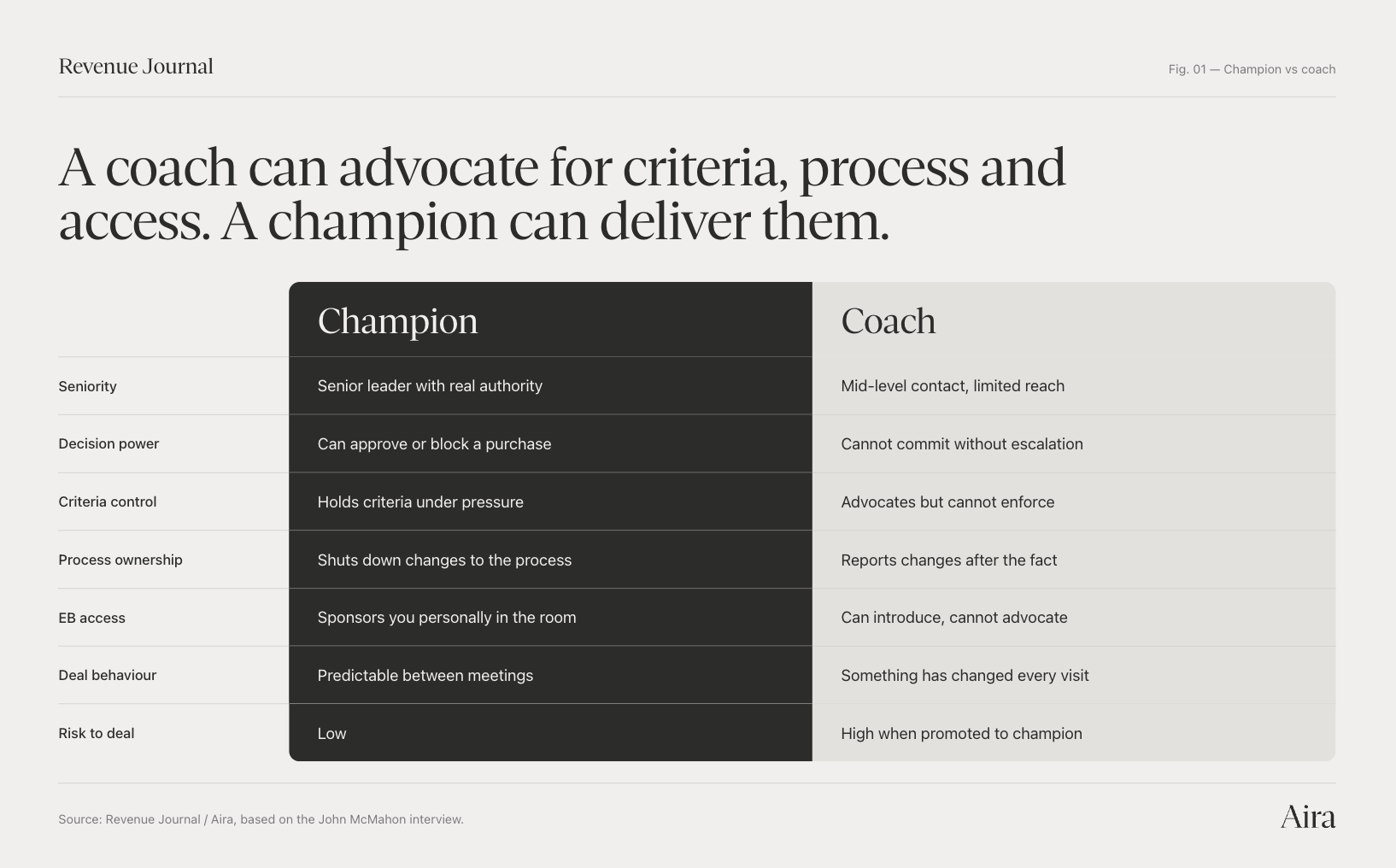
Most teams use champion to describe someone internal who likes them, supports the deal and shares useful information. That is a coach. A coach is valuable. A coach is not a champion.
“The most common mistake is that they mix up a coach with a champion. The coach wants them to win. Coach loves the product. The coach gives them inside information. But the coach just simply doesn’t have the power inside the organisation to control the criteria, control the decision process, and more importantly, get you a meeting and sponsor a meeting to the economic buyer.”
Three capabilities. Criteria control, process control, sponsored access. A coach can advocate for all three and deliver none. Asking a coach to hold your deal is asking someone to guard a door they cannot close.
His tell is not seniority on an org chart. It is whether the deal behaves the same way twice.
“When you don’t have it, you walk into an account, every time you walk in, something’s changed. When you have a really solid champion, because they’re helping you control the criteria and control the process, things move from unpredictable to very predictable.”
Go back through the last four meetings on any live deal. If the ground moved between three of them, and your contact reported each change rather than preventing it, you do not have a champion. You have a well-informed spectator.
MEDDIC was not invented. It was survived.
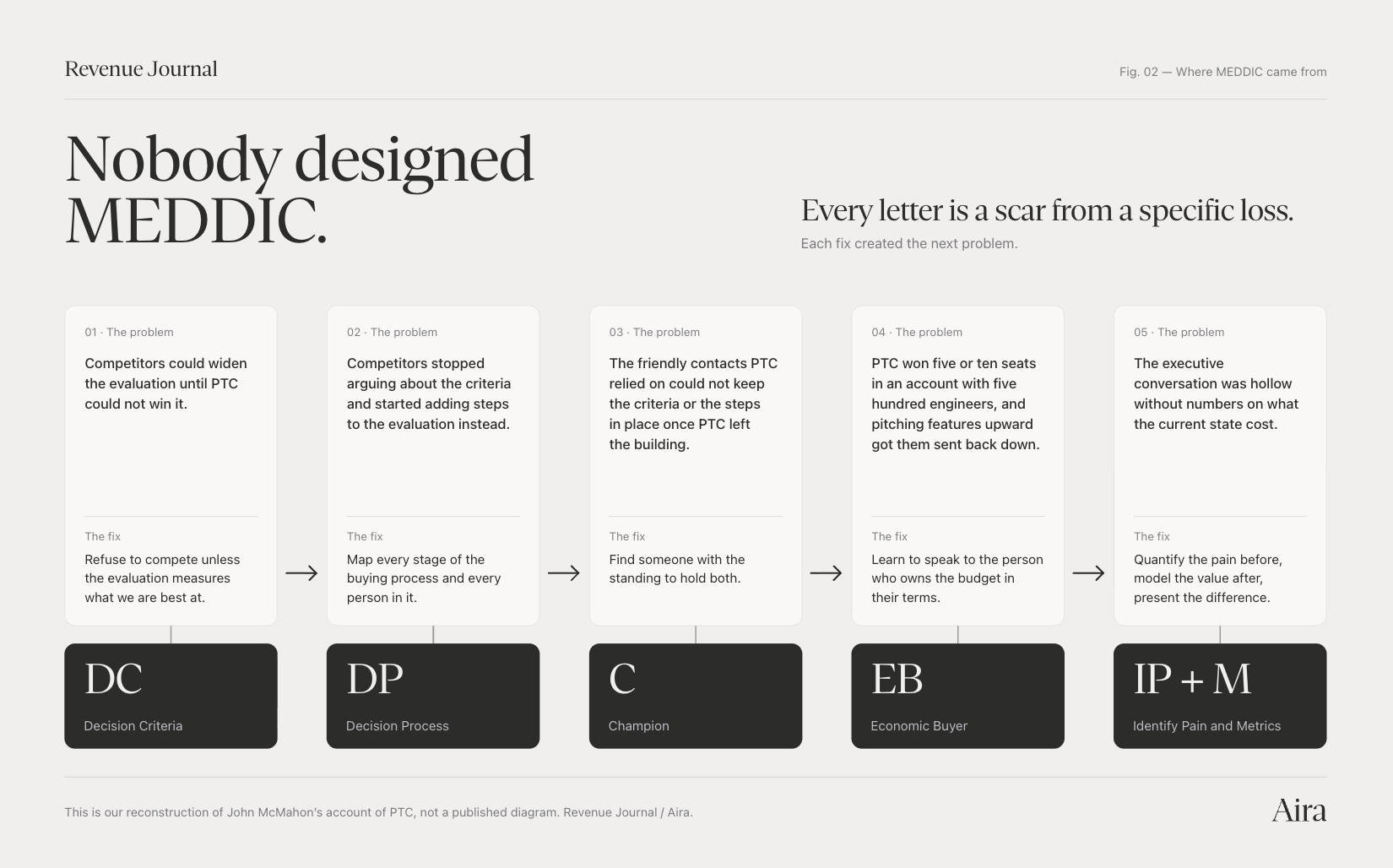
Nobody sat down and designed this. Dick Dunkel and Jack Napoli built MEDDIC at PTC in the 1990s under McMahon’s sales leadership, and they built it out of losing. The practices came first. The letters were codified later.
In the early years the product went through seven major releases before it worked, six months apart. Three and a half years selling software that did not do what it was supposed to do, and the sales motion was what it had to be.
“We were no different than pot and pan salespeople. Or vacuum cleaner salespeople that once they had their foot in the door, they give you a really fancy demo and then they’re really hard to get out of the door.”
Release seven changed the maths. PTC finally had something that could survive a rigorous evaluation, and ran straight into incumbents McMahon describes as billion dollar businesses, already embedded in every account PTC wanted. Lock down the evaluation criteria and they moved the process instead. And the people PTC had been relying on could not stop them.
“We have these coaches, these people that like us a lot, but they don’t seem to have any power. They can’t really control and keep the criteria fixed in that framework that we wanted. And the process keeps changing. Like, this is really frustrating. So let’s go find these people that we call champions that have political power or real technical respect.”
That is the C in MEDDIC. It exists because coaches kept losing deals PTC had already qualified. Each fix exposed the next problem, until the sequence covered everything the framework now names.
“It didn’t happen like when a couple of guys just sat in a room and came up with it. It was something that came out over the years of just getting your head beat in by losing too much.”
The economic buyer needs a champion more than you do
Daniel put a specific loss to him. He’d had the economic buyer, lacked a champion, assumed the economic buyer was enough, and lost the deal. Is that common?
“As salespeople, we need a champion to get us to the economic buyer. But if you’re the economic buyer, you need a champion for the implementation and success of that implementation. I don’t think I’ve seen it in the last ten years or more where an economic buyer is going to make a decision without having a champion that’s totally responsible and bought in to taking the product, implementing that product and making it successful.”
The champion is not a route to the economic buyer. The champion is the condition the economic buyer requires before committing. A senior buyer will not sign for something nobody internal has agreed to own.
So executive access without a champion does not protect the deal. It moves where the deal collapses, from the evaluation to the approval, into a conversation you will not attend. Chris Voss made the same structural point about why B2B deals are lost before the close.
What the confusion costs
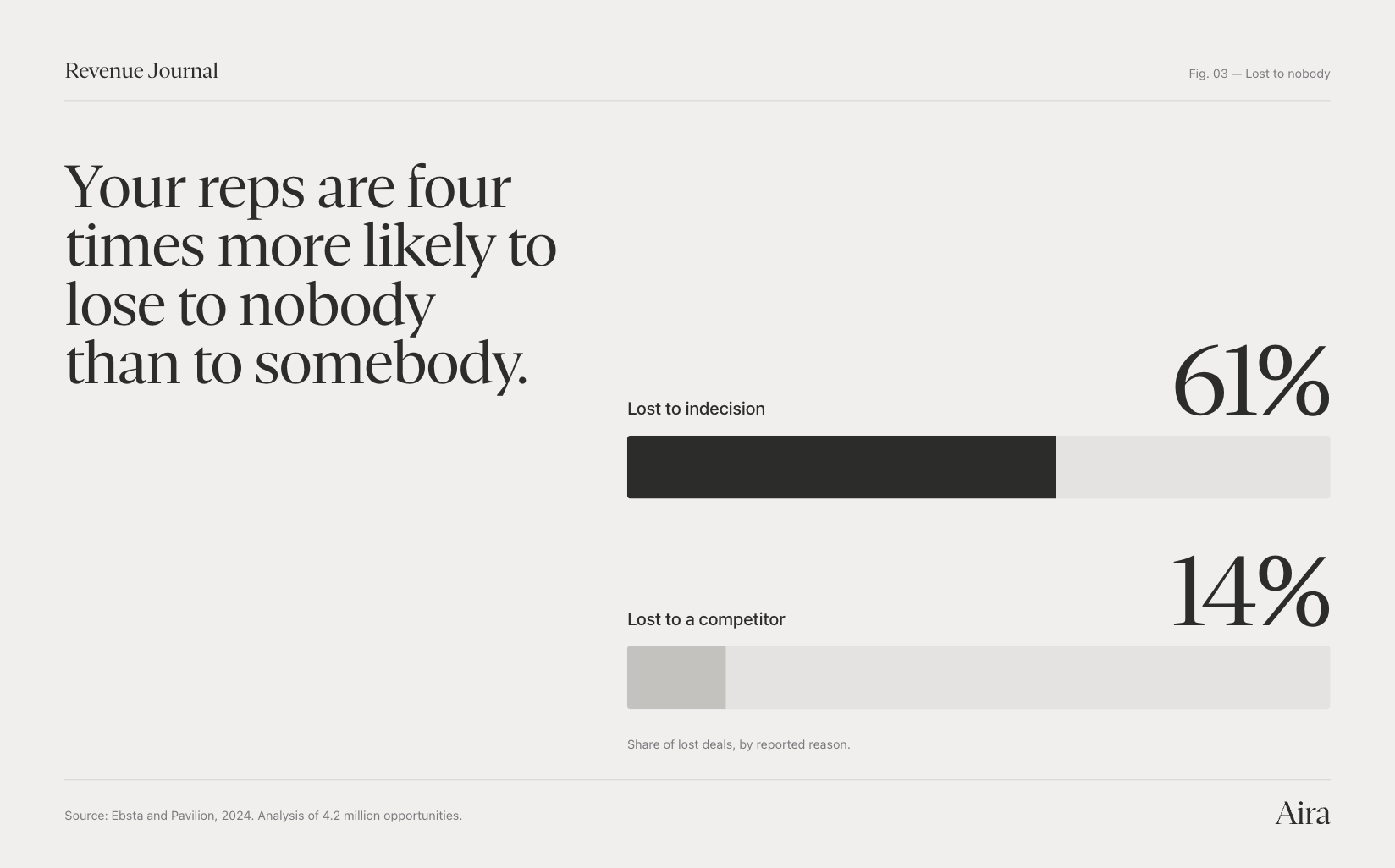
Between 40 and 60 percent of qualified B2B pipeline now ends in no decision rather than a competitive loss, across 2.5 million recorded conversations (Dixon and McKenna, The JOLT Effect, 2022). Ebsta and Pavilion’s analysis of 4.2 million opportunities found 61 percent of lost deals reported as lost to indecision, against 14 percent lost to a competitor (Ebsta and Pavilion, 2024).
Your reps are four times more likely to lose to nobody than to somebody. Which means your enablement function has spent years building a library for the fight you are mostly not having.
Nobody loses to indecision. They lose because nobody inside the account built consensus, and consensus is the champion’s job. Gartner surveyed 632 B2B buyers and found 74 percent of buying teams show unhealthy internal conflict during the decision, while groups reaching genuine consensus are 2.5 times more likely to report a high quality purchase (Gartner, 2025). You are not in the room when that consensus is built.
So if your contact lacks the standing to build it, the deal dies slowly in a meeting you were never invited to, while your CRM tells you it is on track.
We see the same thing. Deals close at roughly three times the rate when a CEO is genuinely involved early in smaller businesses, or a C-suite revenue leader in larger ones. Not a published study. Just a pattern that turns up in enough deals to qualify against.
The reps who lose deals they expected to win are usually the ones who avoid the uncomfortable conversation, the same pattern behind why AI widens the B2B sales performance gap. This is that conversation, and the honest version asks someone you have built a relationship with to admit what they cannot do.
Your competitor has a champion too
“Is the competition’s champion stronger than your champion? In an internal battle, when you’re not there and the competition’s champion’s in the room and your champion’s in the room and they’re having a big discussion, who’s going to win that discussion?”
Most teams ask the question in isolation. Do I have one. McMahon asks it comparatively, which is harder and considerably less comfortable. Not whether you have a champion. Whether yours outranks theirs in a room you will never enter.
He is equally blunt about reps who tell him the question does not apply. Asked who the competition is, they say there isn’t any.
“Ugh. That used to drive me crazy. You always have competition.”
Almost no qualification field has a box for whose champion is stronger. That is the box that decides it.
Replacing the framework never fixes the discipline
Most organisations running MEDDIC are running a CRM labelling exercise. The fields get filled. The rigour does not.
“I think a lot of people don’t really use it. They say they use it. People just use it as like a checkbox because their boss told them to do it, but the boss isn’t really bought in either.”
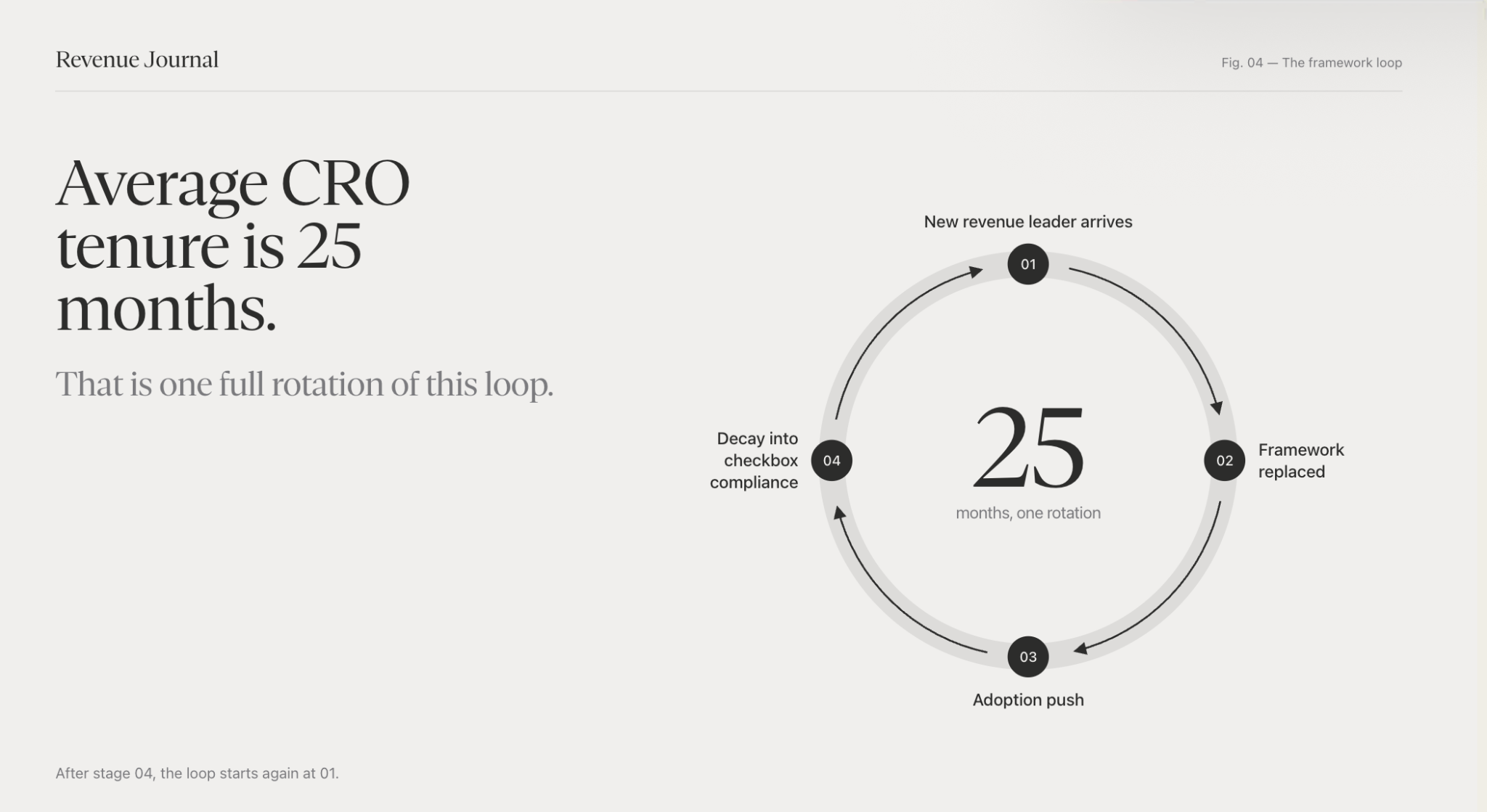
Then new leadership arrives, finds the methodology is not being followed, and reaches for a fresh acronym rather than accountability. Average CRO tenure is 25 months, among the shortest in the C-suite, and 62 percent of companies see revenue growth decline or flatten in the year after a CRO change (SBI Growth, Harvard Business Review, 2024). Two years is one rebuild, one adoption push, one quiet decline into checkbox compliance. Then it restarts.
The old framework was not the problem. The rigour was.
Look at what the gap actually is. Top performing reps are 588 percent more likely to follow methodology effectively, and completing MEDDPICC qualification by the solution presented stage makes a deal 324 percent more likely to be won (Ebsta and Pavilion, 2024). Used properly the framework is diagnostic rather than administrative. When a rep keeps stalling before the champion, ask whether they lack the knowledge or the skill, the same distinction JR Butler drew about hiring for traits rather than credentials. One is fixed in a classroom. The other is fixed by repetition alongside someone who can already do it.
Three questions before the deal enters your forecast
Run these on every active enterprise deal.
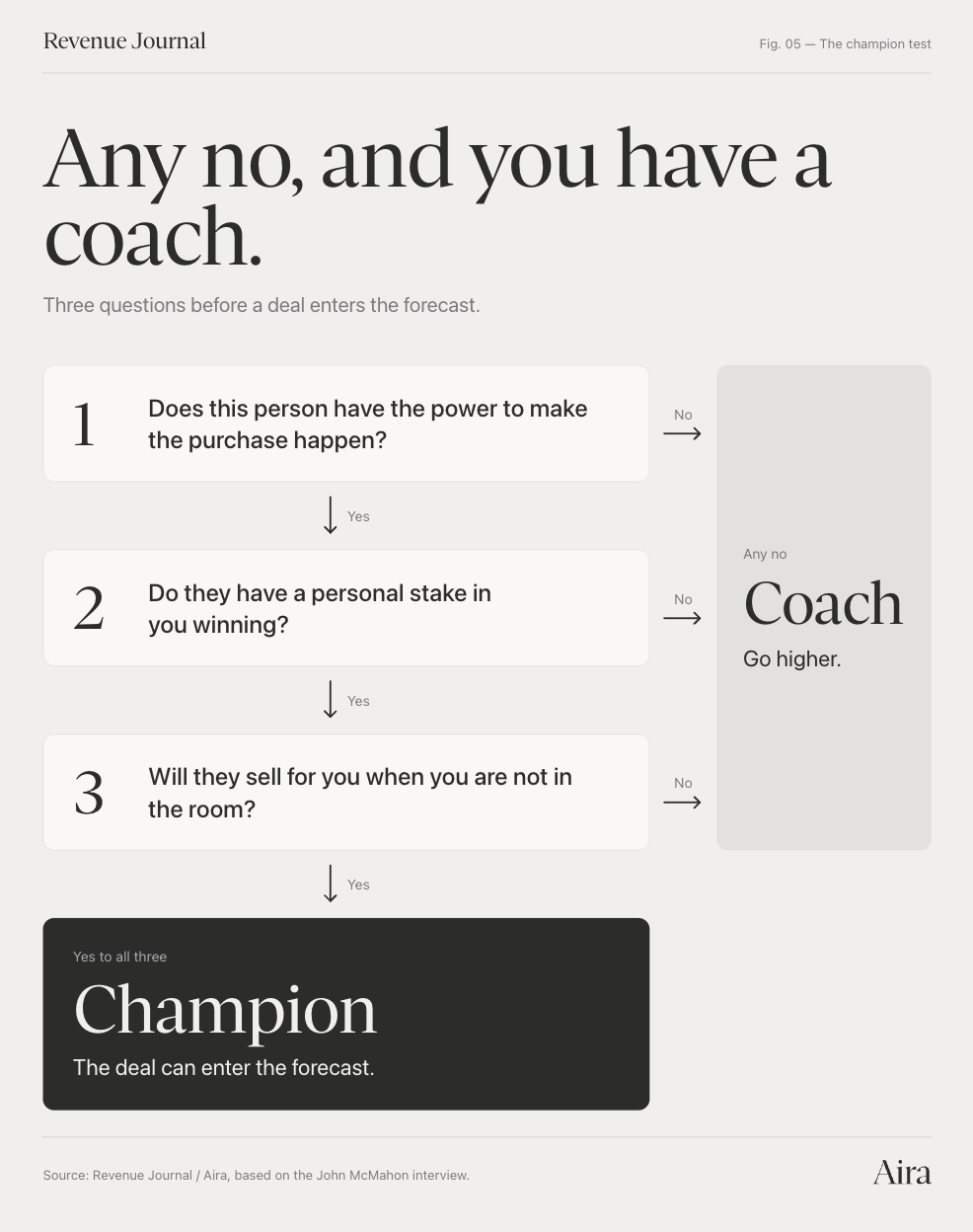
Can they hold the decision criteria if the competition reframes them? A coach argues your case. A champion shuts the reframing down before you hear about it.
Can they get you in front of the economic buyer and sponsor you personally in that room? Not a forwarded introduction. Their credibility attached to the meeting.
Does their endorsement change how others inside the organisation think about the purchase? If their name does not move the internal dynamic, the name is worth less than you think.
Any no, and you have a coach. Go higher, and take the coach with you, because they are usually your best guide to who the champion should be. Then earn the meeting. McMahon’s teams read the annual report and the 10-K risk factors first, and arrived with a problem statement rather than a list of questions, which is how you get thirty minutes from someone who does not give thirty minutes away. Small teams can move first here, for the reasons we set out in how small teams outrun enterprise competitors.
This matters more than any other qualification field because of what it reveals about where you actually are.
“A lot of times if you ask them, well, where are you right now? Oh, I’m in stage three. But when you really start to use MEDDIC and you really start to qualify, you’ll find out, oh, they’re really back here in step two of stage two. They’re not where they think they are.”
He does not think of the framework as a map. He thinks of it as a GPS. The sales process is the route from Boston to New York, the ideal way to go. The GPS is what you need an hour in, when you have pulled off for fuel and need to know where you actually are, where you should have been, and which turns get you back on the road.
Most deals that die at the final stage were never in stage three. The champion conversation is the one that tells you the truth about your position while you can still use it.
Frequently Asked Questions
What is the difference between a champion and a coach in B2B sales?
A champion is a senior leader with real organisational power who can hold the decision criteria under pressure, shut down changes to the evaluation process, and sponsor you personally to the economic buyer. A coach supports the deal and supplies useful intelligence but can do none of those three things. Both are valuable. The failure is placing a coach in the champion role, which surfaces as a late stage loss when the contact cannot hold the process against competitive or internal pressure.
How do you identify whether you have a champion or a coach?
Three tests. Can they hold the evaluation criteria if the competition reframes them? Can they get you a direct meeting with the economic buyer and sponsor you personally in the room? Does their endorsement shift how others inside the company think about the decision? A useful fourth signal is predictability. If something has changed every time you walk back into the account, and your contact reports the change rather than preventing it, you have a coach.
Why does the economic buyer still need a champion if they are making the decision?
Economic buyers need champions for implementation accountability, not for the purchase itself. John McMahon’s position is that in more than a decade he has not seen an economic buyer commit to a significant purchase without an internal owner bought into implementing the product and making it succeed. Access to the economic buyer without a champion does not make the deal safe. It moves the point of collapse from the evaluation to the approval.
Who actually created MEDDIC?
MEDDIC was developed at PTC in the 1990s by Dick Dunkel and Jack Napoli, under the sales leadership of John McMahon. It was not designed in a workshop. It accumulated as a set of field fixes to problems that kept destroying deals, particularly the discovery that supportive mid-level contacts could not hold a process when competitors moved it. The later MEDDPICC extensions, paper process and competition, were formalised afterwards, though McMahon traces both practices to forecasting conversations he ran with his own reps.
Why do sales teams keep replacing MEDDIC with new methodologies?
When new leadership arrives and finds the existing methodology is not being followed, starting fresh is easier than rebuilding rigour around something the team has already disengaged from. With average CRO tenure at 25 months (SBI Growth, Harvard Business Review, 2024), that reset arrives roughly every two years. The framework is rarely the problem. Top performing reps are 588 percent more likely to follow methodology effectively than their peers (Ebsta and Pavilion, 2024), which suggests it works when the discipline exists.
About Tom Deane
Tom Deane is Chief Growth Officer at Aira. He spent eight years as an Account Executive and Key Account Manager in B2B sales before moving into growth leadership. He writes about sales performance, qualification and AI adoption for Revenue Journal. linkedin.com/in/thomas-deane
Contributors
Daniel Wikberg is CEO and Founder of Aira and Upsales. He has spent 20+ years building B2B sales technology, scaling Upsales to a Nasdaq First North listing. linkedin.com/in/danielwikberg
John McMahon is the author of The Qualified Sales Leader and has led worldwide sales at five public enterprise software companies: PTC, GeoTel, Ariba, BladeLogic and BMC. He served on the boards of Snowflake and MongoDB, and sits on the boards of several private software companies. MEDDIC was developed under his leadership at PTC.
About Revenue Journal
Revenue Journal is where B2B executives share first-hand growth strategies and hard-won insights. Published by Aira. www.aira.app/blog