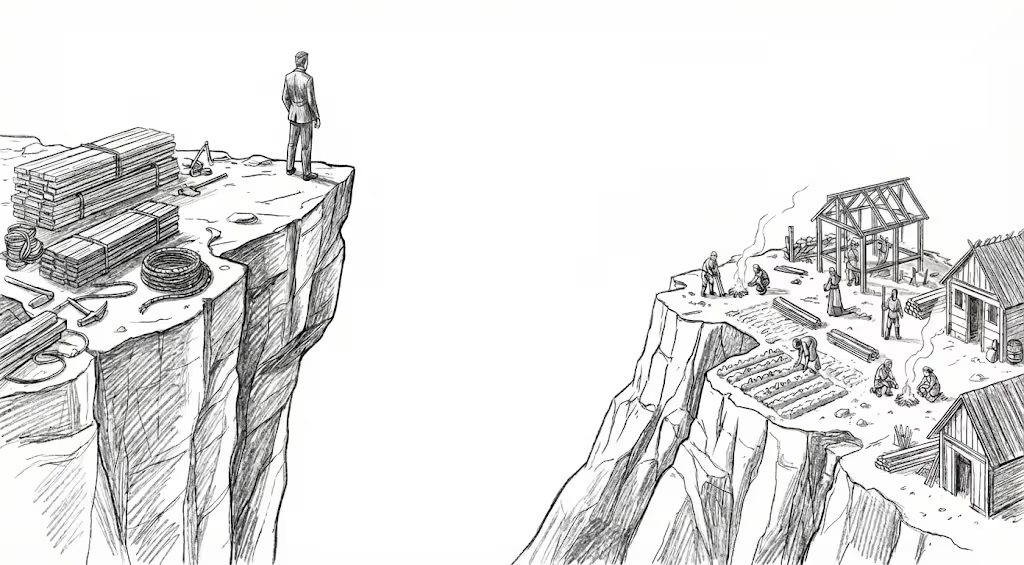
A few years ago I wrote a Linkedin article in Swedish called "Nej, det är inte bara du, alla andra har också jävligt många problem." No, it's not just you, everyone else also has a hell of a lot of problems. The point was simple. Founders look around and assume everyone else has it figured out. They don't. The polished LinkedIn version of other people's lives is fiction. Everyone has problems, you're just only allowed to see your own up close.
I still think that's true. But I want to write the sequel now, because something happened on the Aira world tour that I haven't been able to shake, and it's changed how I lead and how I think about the last few years.
So here we go.
Building a company is a series of defining moments. Everything in between is mostly noise.
When I look back at twenty-something years of running Upsales, there are maybe a dozen of these.
- 2005 — Didn't yet understand that software is a better business than services.
- 2011 — Tore the services side out.
- 2012 — A friend caught what I couldn't see. We were overstaffed. Cut 40%.
- 2017 — Finally got out of the back seat and started actually running the company again.
- 2018 — The Fortnox partnership. Of course we should sign it. What were we even thinking.
- 2019 — Fifteen minutes of coffee with B.A. at Bromma airport. The IPO went from a complicated decision to an obvious one, when every "expert" had been telling me to go another route.
What every one of those moments has in common is that none of them happened in the office. None of them happened in the middle of what we all call work. They happened in cars, on planes, at breakfasts, in coffee shops, in conversations that weren't on any agenda. And almost every single one involved a specific person. Not advice from a panel of advisors, not a McKinsey deck, not an article. One person who happened to have lived something close enough to what I was living to actually be able to see me.
Take that Bromma airport meeting. We were considering an IPO, and I had spent months drowning in input from bankers, lawyers and accountants, all pulling in slightly different directions. B.A. had built a 4,000-person software company before software was even a thing. Fifteen minutes of coffee with him, between flights, and the IPO went from a complicated decision to an obvious one. Not because he had a better spreadsheet. Because he had actually lived a version of what I was living, and could see straight through to the answer.
I've come to think this is the real shape of how a founder grows. You don't grow steadily. You grow in jumps, when the right person catches you at the right moment with the right thing to say.
The crash came in 2023. After fifteen years of growth that just kept compounding, growth went to zero for several quarters.
The market slowed at the same time as we hit internal turbulence in the sales org. Perfect storm. And I made a mistake I'm still slightly embarrassed about. I started questioning everything. I went into what I now call "professional manager mode". We brought in HR consultants. We hired senior people from big tech companies whose decks were prettier than ours. We tried to organise our way out of a growth problem.
Here's the thing I should have known. You cannot HR your way out of a growth problem. That is not how any of this works. The crazy fucking person who had the tenacity to start the company is exactly what was needed to bring it back. We lost twelve months figuring that out. The PowerPoints got more polished. The results stayed flat.
What pulled us out wasn't the pretty decks. It was going back to founder mode. Betting on people who actually knew the business, like Fredrik Höglin , like Stefan Perninge . Trusting their instinct over the imported playbook. Growth came back. We're back to double digits, 13% in the last quarter, returning to +30% margin as we guided in Q1. On its own that doesn't sound like much. But if you look at most listed European software companies in early 2026, that puts Upsales in the rule of 40 category which is not very crowded these days.
And alongside that, I started listening to my own inner ideas again, which is how Aira.app got built. That's a different essay. The relevant point here is that the innovation we did inside Aira is now flowing back into Upsales. We learned things about go-to-market and product that would have been impossible without daring to live outside our own box for a while.
So that's the work part. Now the part I'd rather not write but think I should.
I'm not going to pretend the last three years were easy. Going from fifteen years of high growth to zero for several quarters, rebuilding the sales org almost from scratch, keeping clients happy through it, managing investors as a listed company, while everything else in my personal life was also shifting. People don't see how strange it is to run a local Nordic software business with huge international competitors and try to do it with both high margins and high growth. What kind of crazy person even signs up for this kamikaze mission. While doing all that, I had other big changes in my life, and looking back, it almost broke me.
People kept telling me variations of the same thing. Daniel, you take too much. You're too kind. You don't give yourself credit for what you've done. I heard it for years. I always brushed it off. What other options do I have. There's still so much to do. There's more that's not great than that is great. That was my reaction every time.
Then on the Aira tour I met someone whose words went straight into my nervous system. Same words, basically. But somehow more true than they had been before. I don't fully understand why some people can say something to you that ten others have already said and only their version of it actually lands. But it happens. And when it does, it rearranges things.

I came back from the trip a few days later and something had shifted. I looked at what I had built and I felt proud. I think for the first time in twenty-five years. But I also saw my role in a different light. I had always held the team to high standards, and I still do. But I also saw, clearly, that I had been quietly covering for inefficiencies in the org for years. Masking them. Compensating with my own time and energy. In effect, using my health and well-being as venture capital. And venture capital has to be paid back eventually, with interest.
It took me a few more weeks at home to fully realise how close I'd been pushing it. Twelve to fourteen hour days for most of the last year. Always one more thing. Always one more fire. Then the fire goes out and you look around and you can't quite remember the last time you felt rested. That's not a sustainable input into anything, let alone a company you want to keep building for another decade.
Here is what changed when I came back, and what I want to write down because I think other founders will recognise it.
I stopped trying to push high standards onto the team. I started expecting them instead.
The difference sounds small. It is enormous. Pushing is exhausting and it scales with effort, which means the moment you stop pushing, performance falls. Expecting is calm, and it scales with culture, which means the standard holds even when you're not in the room. The clearest version of this I can give you is a promise I've made to myself: never work with people you have to say the same thing to twice. Once is coaching. Twice is a signal. There is no third time.
I stopped tolerating low performance and trying to "yell people to performance". You cannot yell someone into being someone they're not. You exhaust them and you exhaust yourself. Life is too short. There are extremely talented people out there, and the difference between good and great is much bigger than people admit.
Take my new CFO. She operates on a level I've rarely seen, and what I didn't expect is how far her impact reaches beyond finance. The way she thinks shows up in how the rest of the leadership team frames decisions. The clarity she brings to a number ends up clarifying things three departments away. People like that exist. They are rarer than they should be, but they exist. Once you've worked with one, the cost of keeping someone who isn't pulling their weight becomes unbearable, not in some abstract way, but viscerally, every Monday morning. Don't settle for less.
I stopped covering. If something in the org isn't working, the org has to feel that, not me. Otherwise nothing changes and I just slowly burn out while everyone else assumes things are fine.
So back to the original piece. Nej, det är inte bara du. No, it's not just you. Every other founder is also dealing with a pile of problems they haven't told anyone about. That part is still true. But I want to add something to it now.
You're not going to think your way out of it. You're not going to read your way out of it. You're going to meet someone, somewhere outside the office, who happens to say the right thing to you in the right way at the right moment, and a small thing in you will rearrange. And then your job is to listen to it.
Try to put yourself in places where that can happen. Travel. Show up at things you wouldn't normally go to. Have the breakfast. Take the meeting. Sit next to the stranger.
The decisions that change a company never get made in the middle of what we all call work.